
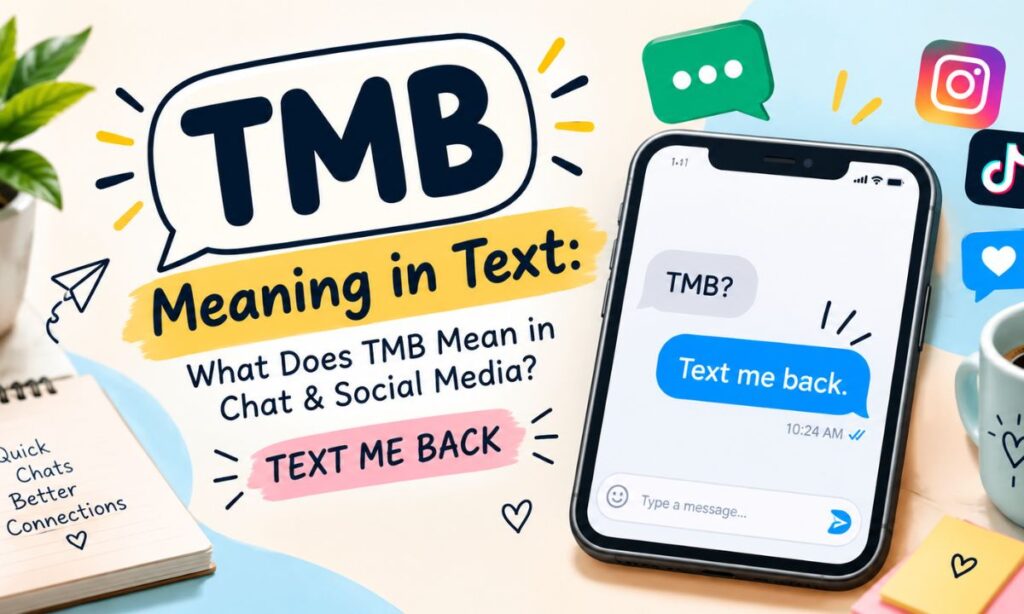

You get a text that just says “tmb” and nothing else. No context, no punctuation. If you’re not sure whether to reply right away or ignore it, you’re not alone. TMB is one of those short texting abbreviations that looks harmless but can carry a surprising amount of urgency depending on who sent it.
This guide breaks down exactly what TMB means, where it came from, how it shows up across different apps and languages, and how to reply without overthinking it.
What Does TMB Mean in Text & Chat?
TMB most commonly stands for “Text Me Back.” It’s a short, casual way of asking someone to reply to a message, usually because the sender is waiting on an answer, wants to keep a conversation going, or just wants confirmation about something. It shows up at the end of texts, DMs, and comments across nearly every messaging platform.
TMB is not offensive by default. Its tone depends entirely on context, punctuation, and the relationship between the people texting.
Full Form, Stands For & Short Meaning of TMB
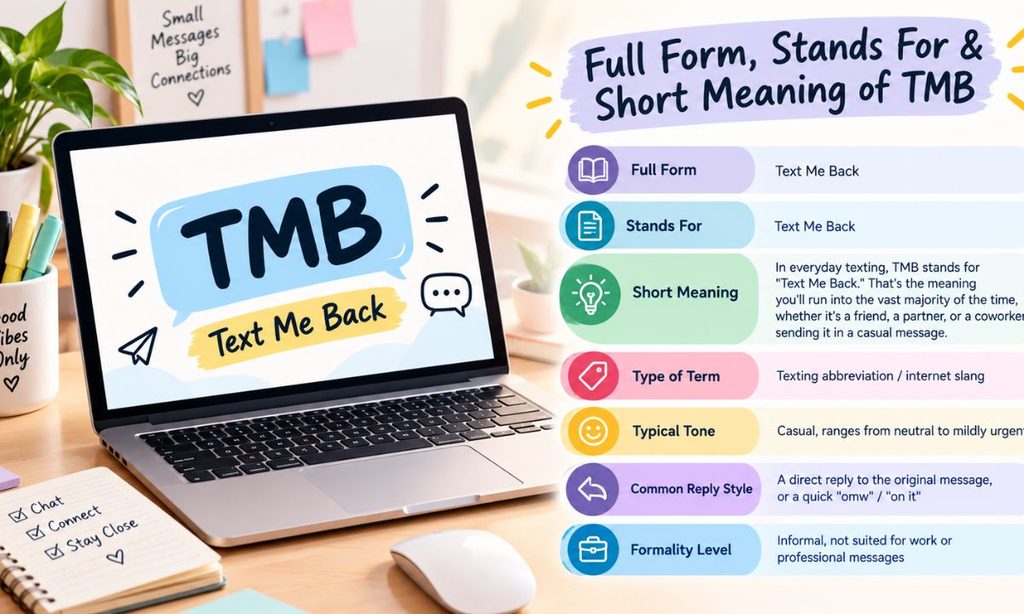
In everyday texting, TMB stands for “Text Me Back.” That’s the meaning you’ll run into the vast majority of the time, whether it’s a friend, a partner, or a coworker sending it in a casual message.
| Detail | Explanation |
|---|---|
| Full form | Text Me Back |
| Type of term | Texting abbreviation / internet slang |
| Typical tone | Casual, ranges from neutral to mildly urgent |
| Common reply style | A direct reply to the original message, or a quick “omw” / “on it” |
| Formality level | Informal, not suited for work or professional messages |
Origin, History & First Known Use of TMB
TMB grew out of the same texting culture that produced abbreviations like TTYL and BRB, back when character limits and slow keypads made short forms genuinely useful. As smartphones and social apps took over in the early 2010s, the abbreviation carried over into DMs, comments, and captions, where it settled into its current role as a quick nudge for a reply.
Unlike some slang terms with a single traceable origin, TMB doesn’t come from one platform or moment. It’s a natural shorthand that emerged wherever people needed a fast way to say “reply to me” without typing the full phrase.
How People Use TMB in Daily Conversations
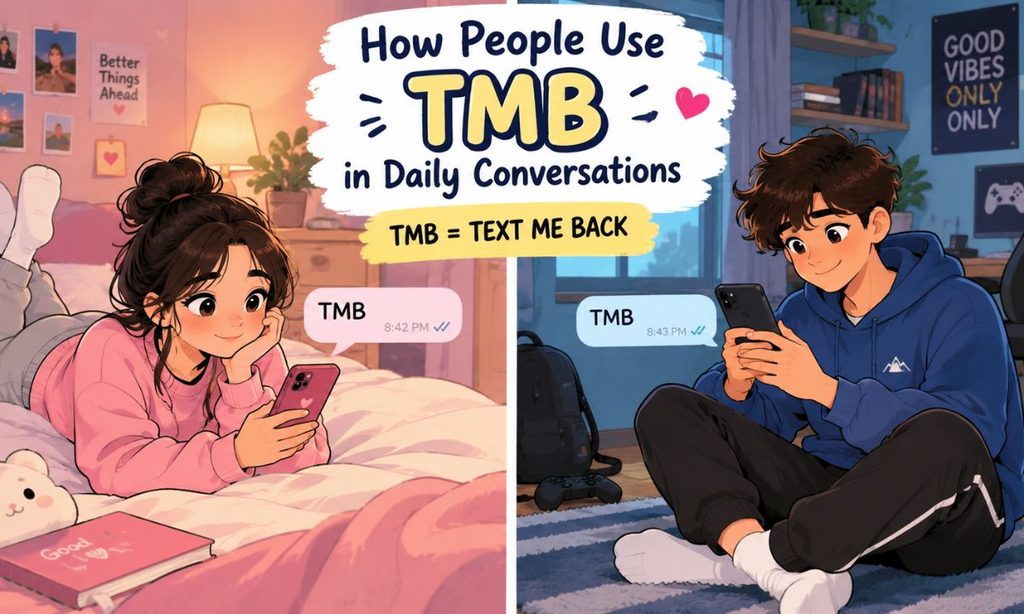
Most of the time, TMB works exactly the way it looks: a reminder or request tacked onto the end of a message. What changes is the emotional weight behind it, and that comes down to relationship and tone rather than who sent it.
- Between friends, TMB usually reads as casual and low-pressure, closer to “let me know when you can.”
- In romantic or flirty texting, TMB can carry a softer, more emotional undertone, especially after a long conversation dies out.
- In work-adjacent or unfamiliar chats, TMB can feel abrupt or even slightly demanding, since it skips the usual pleasantries.
- In group chats, TMB often shows up when one person is trying to get a decision made, like confirming plans or reservations.
A claim you’ll see repeated across some slang sites is that TMB “means something different depending on whether a girl or a guy sends it.” That’s not accurate. TMB’s meaning doesn’t change based on the sender’s gender. What actually shifts the tone is the relationship between the two people texting, the conversation that came before it, and how the message is punctuated, not who happens to be typing it.
TMB Meaning Across WhatsApp, Instagram, TikTok & Snapchat
TMB shows up on nearly every major messaging app, but the exact flavor of it shifts slightly by platform.
| Platform | Typical Usage |
|---|---|
| Standard “Text Me Back,” often used as a casual reminder in group or one-on-one chats | |
| Usually “Text Me Back” in DMs, though it occasionally means “Tag Me Back” in comment threads during photo challenges | |
| TikTok | Appears in comments as a prompt for someone to reply or continue an inside joke |
| Snapchat | Common as a quick nudge after sending a snap, asking for a response before the streak or conversation goes cold |
Across all four platforms, “Text Me Back” remains the meaning you should assume by default. The Instagram “Tag Me Back” variant only applies in specific comment-thread contexts, like photo trends where people are tagging friends to join in.
TMB Meaning in Spanish Texting
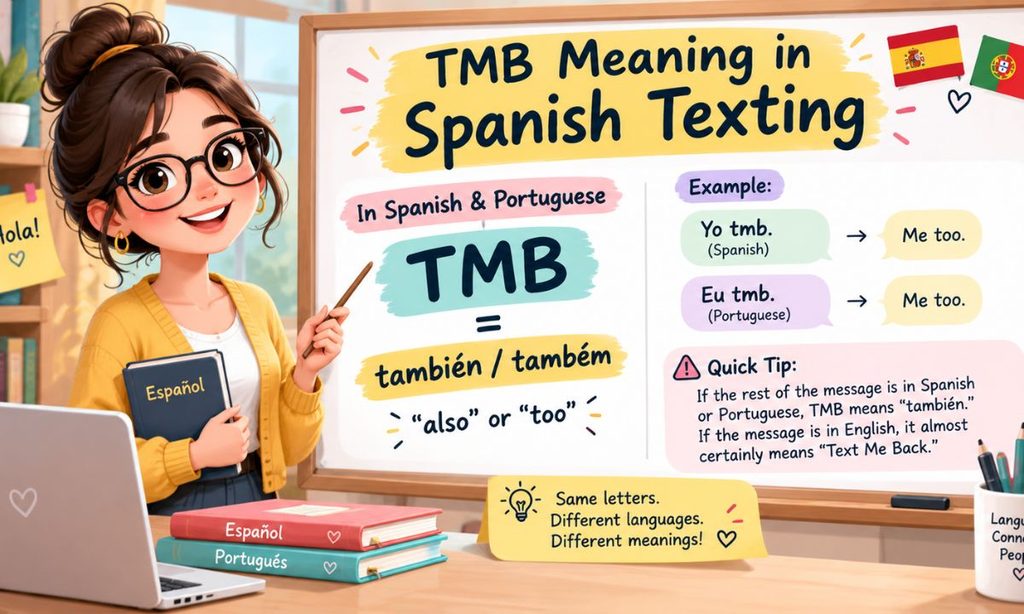
In Spanish and Portuguese texting, “tmb” is a completely different abbreviation. It’s short for “también” (Spanish) or “também” (Portuguese), meaning “also” or “too.” So if a Spanish-speaking friend texts “yo tmb,” they’re saying “me too,” not asking you to text them back.
This overlap is a genuine, well-documented source of confusion in bilingual conversations. If the rest of the message is in Spanish or Portuguese, “tmb” almost certainly means “también.” If the message is in English, it almost certainly means “Text Me Back.”
Different Meanings of TMB in Other Fields
Outside of texting, TMB has a few unrelated but well-documented meanings in professional and technical fields.
TMB in Medicine

In oncology, TMB stands for Tumor Mutational Burden, a measurement of how many genetic mutations are present in a tumor’s DNA. Doctors use TMB as one factor in deciding whether certain cancer treatments, particularly immunotherapy, are likely to be effective. A higher tumor mutational burden can sometimes indicate a better response to specific immunotherapy drugs, since more mutations can make a tumor more recognizable to the immune system.
TMB in Chemistry and Lab Testing

TMB also refers to 3,3′,5,5′-Tetramethylbenzidine, a chemical compound used as a color-changing indicator in lab tests, including ELISA assays and certain fecal occult blood tests. It reacts with specific enzymes to produce a visible color change, which is what makes it useful for detecting the presence of a substance in a sample.
TMB in Business and Organizations
TMB can also refer to specific companies and organizations, most notably TMB Bank, a Thai financial institution. In these contexts, the letters function as a brand name or ticker-style abbreviation rather than a phrase, so the surrounding context (a business article versus a text message) makes the intended meaning obvious.
Also Read This:MYF Meaning in Text: What Does MYF Mean in Chat & Social Media?
Common Confusions, Mistakes & Wrong Interpretations
A few mix-ups come up repeatedly around TMB, and it’s worth knowing which ones are backed by real usage and which are fringe.
- Confusing TMB with TMI. These look similar but mean completely different things; TMI stands for “Too Much Information.”
- Assuming TMB is always aggressive. Urban Dictionary lists a more confrontational variant along the lines of “Try Me, B***h,” but this is a niche, unverified usage compared to the dominant “Text Me Back” meaning, and it’s not something you should assume unless the surrounding message is clearly hostile.
- Missing the language switch. Reading Spanish “tmb” (también) as the English “text me back” is the single most common real-world mix-up.
- Ignoring punctuation and tone. A bare “TMB.” with a period can read as cold or final, while “tmb!” or “tmb 😊” softens it considerably.
Similar Terms, Alternatives & Related Slang
| Term | Meaning |
|---|---|
| TBH | To Be Honest |
| TBT | Throwback Thursday |
| MMB | Message Me Back |
| CMB | Comment Me Back |
| IDC | I Don’t Care |
| OMW | On My Way |
Examples of TMB in Real Chat Situations
- “Beach this Saturday? TMB” — asking for a quick yes or no to lock in plans
- “Sent you the file, tmb when you check it” — a reminder tied to a specific task
- “Guys seriously TMB we need reservations” — used in a group chat to push for a decision
- “Miss talking to you, tmb sometime” — a softer, more emotional use after a quiet stretch
- “Yo tmb, fue una locura ese día” — Spanish usage meaning “me too,” unrelated to texting back
How to Reply When Someone Says TMB
There’s no single correct response, but a few approaches cover most situations:
- Just answer the original question directly if there was one.
- Send a quick placeholder if you’re busy: “at work, tmb tonight.”
- Match the tone: playful TMB gets a playful reply, a flat one-word TMB can just get a straightforward answer.
- If you suspect it’s the Spanish “también,” respond in kind rather than assuming they want a reply to something specific.
Is TMB Still Popular? Trends & Online Usage
TMB has stayed consistent texting slang since the early smartphone era, and it remains common in 2026 across casual messaging, particularly among teens and young adults. It hasn’t faded the way some short-lived slang terms have, mostly because it fills a genuinely useful, simple function: asking for a reply without typing out the full phrase.
Quick Facts Section
| Question | Quick Answer |
|---|---|
| What does TMB mean? | Text Me Back, in nearly all English-language texting |
| Is TMB rude? | Not inherently; tone depends on punctuation and relationship |
| Does TMB mean the same thing in Spanish? | No, it means “también” (also/too) |
| Is TMB used in medicine? | Yes, as Tumor Mutational Burden, an unrelated oncology term |
| Should I use TMB at work? | No, spell out the request in professional messages |
Final Thoughts
TMB looks like a simple three-letter nudge, but its meaning shifts depending on the language, platform, and relationship behind it. In English texting, it almost always means “Text Me Back.” In Spanish or Portuguese, it means something else entirely. And outside of casual chat, it has real, unrelated meanings in medicine and lab science. Reading the context around the letters, rather than assuming one fixed meaning, is what makes TMB easy to interpret every time you see it.
Frequently Asked Questions
What does TMB mean in a text message?
TMB most commonly means “Text Me Back,” a casual request or reminder asking someone to reply.
Is TMB the same as TMI?
No. TMB means “Text Me Back,” while TMI means “Too Much Information.” They’re unrelated despite the similar look.
What does TMB mean in Spanish texting?
In Spanish and Portuguese, “tmb” is short for “también,” meaning “also” or “too,” and has nothing to do with texting someone back.
Is it okay to use TMB in a work chat?
It’s best to avoid it. TMB is casual slang, so spelling out your request reads as more professional in work or formal messages.
Does TMB always mean the sender is annoyed?
No. TMB is a neutral term by default; tone depends on punctuation, context, and the relationship between the people texting, not the abbreviation itself.



Pingback: WTD Meaning in Text: What Does WTD Mean in Chat & Social Media?