
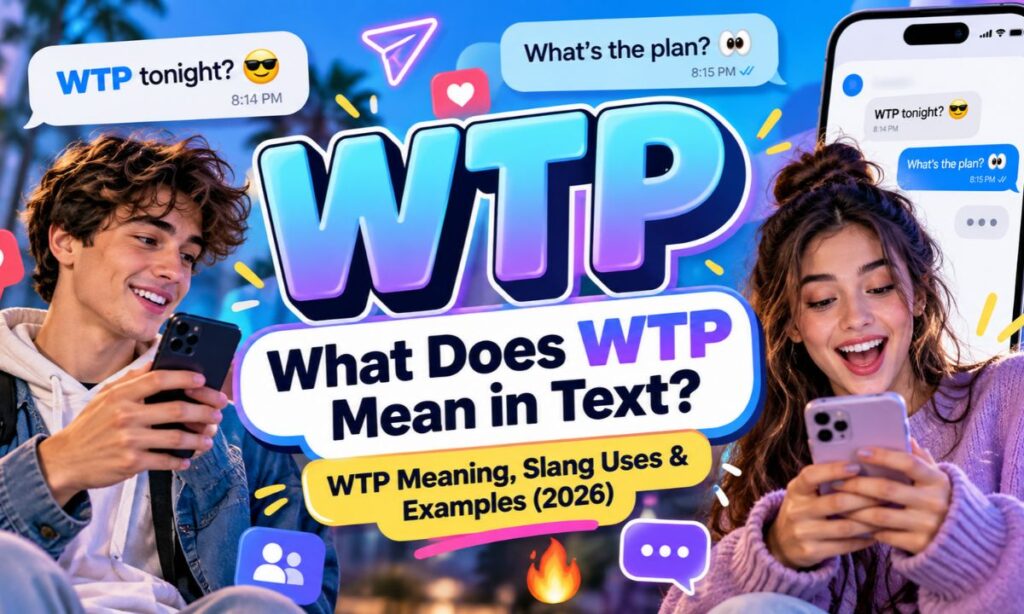

WTP in text most often means “what’s the plan?” It is a quick way to ask what someone is doing or where the evening is heading. The same three letters can also mean “where’s the party?” or “what’s the point?”, and outside texting they stand for “willingness to pay” in business and economics.
Because several meanings are in circulation, the sender’s tone and the conversation around the message decide which one applies. A “wtp tonight?” from a friend is about plans. A “wtp anymore” after a bad week is something else entirely.
This guide explains each meaning, shows how to tell them apart, and covers the business and economics definitions so you can land on the right answer whichever WTP you came across.
What Does WTP Mean in Text – Quick Meaning
WTP most commonly means “what’s the plan?” or “what’s the play?” Dictionary.com lists it as a textspeak acronym, usually used when people are organizing an evening outing. Other readings exist, and context tells you which one fits.
- What’s the plan? / What’s the play? The best documented texting meaning, used to ask about plans.
- Where’s the party? Listed by some slang dictionaries, used when looking for a gathering.
- What’s the point? Reported by some slang sites, used to express doubt or frustration.
- We the People: The opening words of the preamble to the US Constitution.
- Willingness to pay: A pricing and economics term, not a texting one.
Origin & Background
There is no reliable record of who first used WTP in text or when. It follows the usual pattern of texting shorthand, where a familiar phrase is cut down to its initials so it can be typed fast. Dictionary.com documents “what’s the plan” and “what’s the play” as the textspeak meaning, and separately notes “we the people.” Slang dictionaries add “where’s the party.”
Some smaller slang sites also list “what’s the point” and “want to play,” but those claims are less consistently documented. Treat them as readings that depend on context rather than settled definitions, and be cautious with any page that gives an exact year or community of origin.
Wtp meaning in business

In business, WTP means willingness to pay, the maximum amount a customer is prepared to spend on a product or service. Companies use it to set prices that match the value customers see.
- Direct WTP: Customers are asked outright what they would pay.
- Indirect WTP: It is inferred from behavior, such as purchases and reactions to different prices.
- Marginal WTP: The extra amount a customer will pay for an added feature or a quality upgrade.
Suppose a scheduling tool saves a team several hours a week. Business buyers may accept a higher price for it than for a basic version. WTP marks the ceiling for a price, not the price itself, and it shifts over time, so pricing teams recheck it regularly.
Also Read This:What Does NFSS Mean in Text? NFSS Meaning, Slang Uses & Real Examples
Real-Life Conversations
- “wtp tonight?” asks about evening plans. A typical reply is “idk, dinner then maybe a movie?”
- “wtp for Friday? Everyone’s free after 7” is group planning.
- “wtp rn” asks what the plan is right now.
- “wtp, anyone throwing something this weekend?” leans toward “where’s the party?”
- “honestly wtp anymore” reads as discouragement, closer to “what’s the point?”
The first four are about logistics. Only the last one changes the emotional weight, and the words around “wtp” are what signal that.
Emotional & Psychological Meaning
The abbreviation itself carries no fixed emotion. Any feeling comes from punctuation, wording, and the situation, and the cues below are common-sense reading habits, not research findings.
- “wtp lol” or “wtp tonight :)” reads relaxed and friendly.
- “wtp??” can read impatient, as if the sender wants a decision.
- “wtp anymore” or “wtp with all this” reads frustrated or doubtful.
If a friend sends “what’s the point” about their life in general, not about a plan or a task, take it seriously and check in with them directly.
Usage in Different Contexts
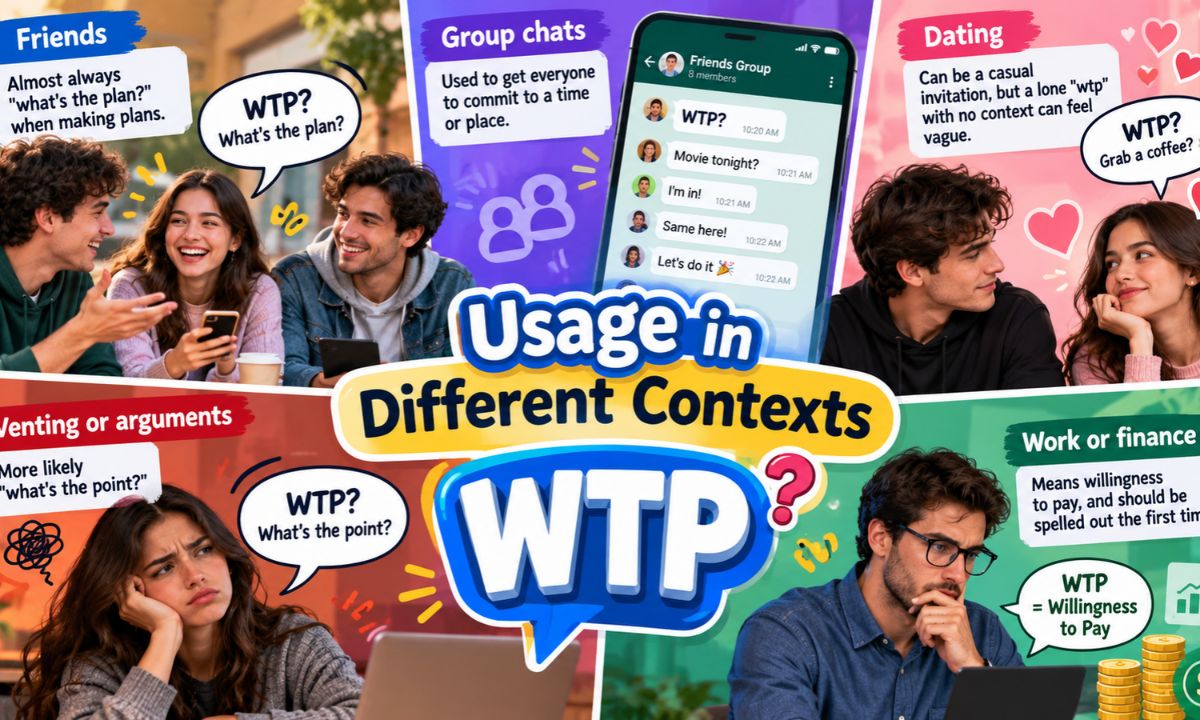
- Friends: Almost always “what’s the plan?” when making plans.
- Group chats: Used to get everyone to commit to a time or place.
- Dating: Can be a casual invitation, but a lone “wtp” with no context can feel vague.
- Venting or arguments: More likely “what’s the point?”
- Work or finance: Means willingness to pay, and should be spelled out the first time.
When NOT to Use It
- In work messages, where colleagues may read it as “willingness to pay” or not recognize it at all.
- In serious or emotional conversations, where “what’s the plan” and “what’s the point” are easy to confuse.
- With people who do not use texting slang, such as older relatives or new contacts.
- In formal writing, where the full phrase is clearer.
Common Misunderstandings
- Assuming one meaning always applies. The texting meanings overlap, so read the surrounding messages first.
- Assuming it is negative. The most documented meaning is simply a question about plans.
- Mixing up slang and business use. A pricing report that says “WTP” is not talking about plans.
- Unrelated technical uses. WTP also abbreviates Wireless Transaction Protocol, a layer of the Wireless Application Protocol used in mobile telephony, and water treatment plant.
- Song titles. At least one album track is titled “WTP,” which is a separate use again.
Comparison Table
Use this cheat sheet to match the meaning to the situation.
| Meaning | Where It Appears | Typical Tone | Clue to Look For |
|---|---|---|---|
| What’s the plan? / What’s the play? | Texts, group chats | Casual, upbeat | A time, place, or “tonight” |
| Where’s the party? | Texts, social media | Playful | Mention of a party or gathering |
| What’s the point? | Venting, arguments | Frustrated, doubtful | “anymore,” “with this,” or a complaint |
| We the People | US politics, history | Formal | Constitution or civic topic |
| Willingness to pay | Business, economics | Neutral, technical | Price, customers, or market |
Wtp economics meaning
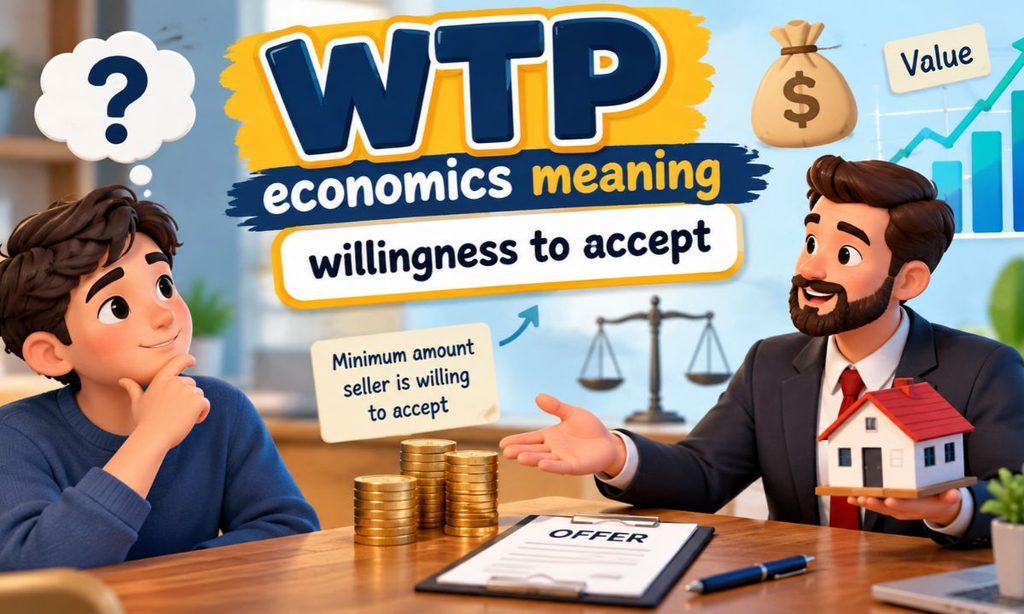
In economics, willingness to pay is the highest price a buyer would accept for a good or service. Across a whole market, those individual maximums form the demand curve, so the demand curve is effectively a picture of everyone’s WTP.
Its counterpart is willingness to accept, the lowest price a seller will take, which maps to the supply curve. A sale happens where a buyer’s WTP meets a seller’s willingness to accept.
WTP is not fixed. It depends on context. The same soft drink commands a higher price at a luxury resort than at a beach bar or a local shop, because the setting changes what buyers will accept.
Researchers measure it with surveys, conjoint analysis, and auction experiments. Direct survey questions are popular, but they can suffer from hypothetical bias, meaning people say one thing and pay another.
Variations / Types
- wtp rn: What’s the plan right now.
- wtp tonight / wtp tmrw: Plans for a specific time.
- wtp anymore: Usually the “what’s the point” reading.
| Similar Term | Meaning | How It Differs from WTP |
|---|---|---|
| WYD | What you doing | Asks about the present activity, not the plan |
| WYA | Where you at | Asks for a location |
| WSG | What’s good | A general greeting, no plan implied |
How to Respond When Someone Uses It
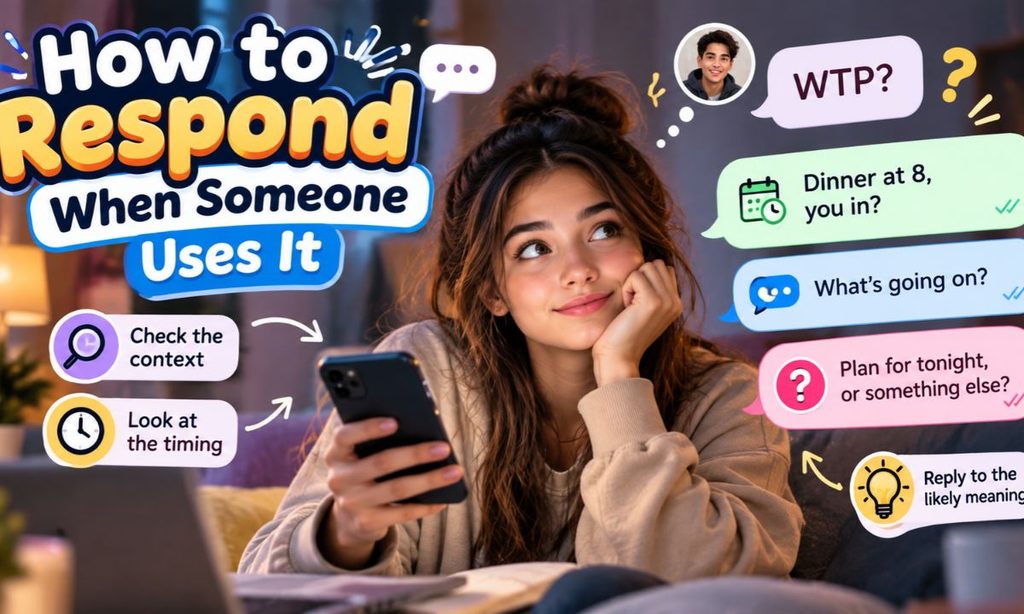
Work out the meaning first, then match the tone.
- Look at the surrounding messages for a time, place, or complaint.
- Check the timing, since an evening message usually points to plans.
- Reply to the likely meaning: “dinner at 8, you in?” for plans, or “what’s going on?” for a discouraged message.
- If you still cannot tell, ask: “plan for tonight, or something else?”
Regional & Cultural Usage
I found no reliable documentation of regional differences in how texting WTP is used. The variation that shows up is by social circle and context, not by country. The one clear cultural link is “we the people,” tied to the United States, so in American political or historical writing the letters may carry that meaning instead.
Is It Safe for Kids?
The abbreviation has no profanity and is mild in itself. Parents should still read the message around it. “Where’s the party” may point to a social event worth asking about, and “what’s the point” paired with sadness is worth a calm conversation.
FAQs
What does WTP mean in a text message?
It most commonly means “what’s the plan?” or “what’s the play?”, used to ask about plans, often for the evening.
Does WTP mean “what’s the point”?
Sometimes, in frustrated or doubtful messages, though this reading is less consistently documented than “what’s the plan.” Look for words like “anymore” to confirm.
What does WTP mean in business?
It means willingness to pay, the maximum price a customer will spend on a product or service.
Is WTP the same as WYD?
No. WYD asks what someone is doing now, while WTP asks about plans.
How do I know which WTP meaning someone intends?
Check the timing, the punctuation, and the words around it, and ask them if it is still unclear.
Conclusion
WTP most often means “what’s the plan?” in texting, with “where’s the party?” and “what’s the point?” as context-dependent alternatives. In business and economics it means willingness to pay, the highest price a buyer will accept.
Read the surrounding messages, the timing, and the topic, and the right meaning is usually clear. When it is not, a quick question clears it up faster than a guess.


Pingback: What Does IMS Mean in Text? IMS Meaning, Slang Uses & Chat Examples (2026)
Pingback: 🌙 Moon Emoji Meaning: What Does the Moon Emoji Mean in Text? (2026)