
Quick Answer Box
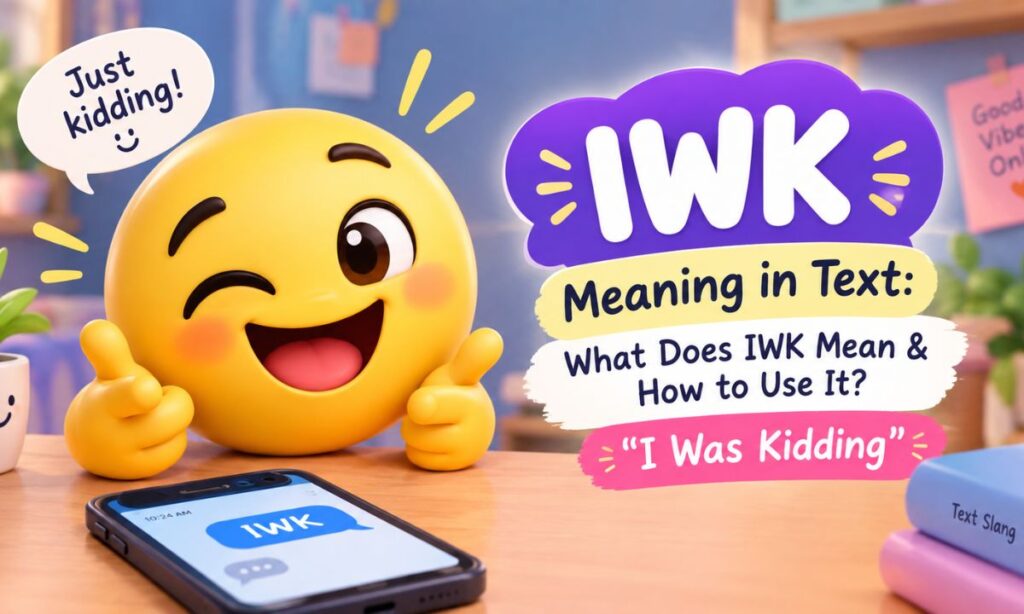
IWK most commonly stands for “I Was Kidding.” People add it right after a dramatic, exaggerated, or surprising statement to clarify that they weren’t being serious. Documentation on this term is thinner than most texting slang, so while “I Was Kidding” is the leading, most-repeated meaning, it’s worth treating as the strongest interpretation rather than an absolute rule.
What Does IWK Mean In Text?
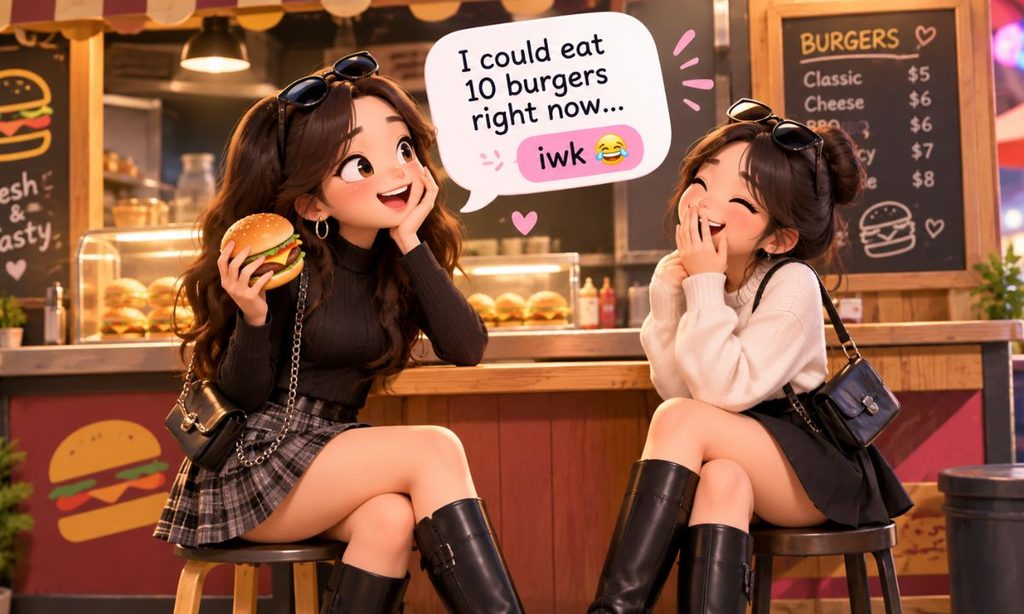
In texting, IWK usually shows up as a quick retraction tag. Someone makes a bold or over-the-top claim, then immediately follows it with “iwk” to soften it: “I could eat 10 burgers right now… iwk 😂.” The point is to make sure the joke lands as a joke instead of being taken at face value.
Because text has no tone of voice, this kind of clarifier fills a gap that a raised eyebrow or a laugh would normally handle in person.
Iwk meaning from a girl
Some guides split IWK’s meaning by the sender’s gender, suggesting it means something different coming from a girl versus a boy. That distinction doesn’t hold up. IWK carries the same core meaning, “I was kidding,” regardless of who sends it.
What actually shifts the tone is the relationship and the conversation itself, not gender. An IWK after a playful exaggeration between close friends reads as lighthearted no matter who typed it, while an IWK used to walk back something more pointed can feel more like damage control, again independent of the sender’s gender.
Origin And Evolution Of IWK
Unlike well-documented texting classics such as LOL or JK, IWK doesn’t have a clear, single-point origin story. It appears to have picked up light traction more recently, spreading through texting and gaming chats as one of several short “just kidding” style tags people use to soften exaggerated statements.
It hasn’t reached anywhere near the recognition level of its closest sibling, JK, which remains far more universally understood.
Psychological And Emotional Meaning Of IWK
IWK functions as a small piece of social cushioning. It reduces the risk that an exaggerated or startling statement gets taken literally, which matters in text since there’s no vocal inflection or facial expression to signal a joke.
Sending it shows a bit of consideration, an acknowledgment that the previous message could have landed the wrong way, followed by a quick effort to fix that before it causes confusion or worry.
Communication Function Of IWK
Structurally, IWK works as a retroactive softener. It lets someone make a dramatic or surprising statement first, then immediately walk it back, rather than having to phrase the joke carefully from the start.
That two-step pattern, exaggerate first, clarify second, is part of what gives IWK its casual, joking tone.
Cultural And Generational Context Of IWK
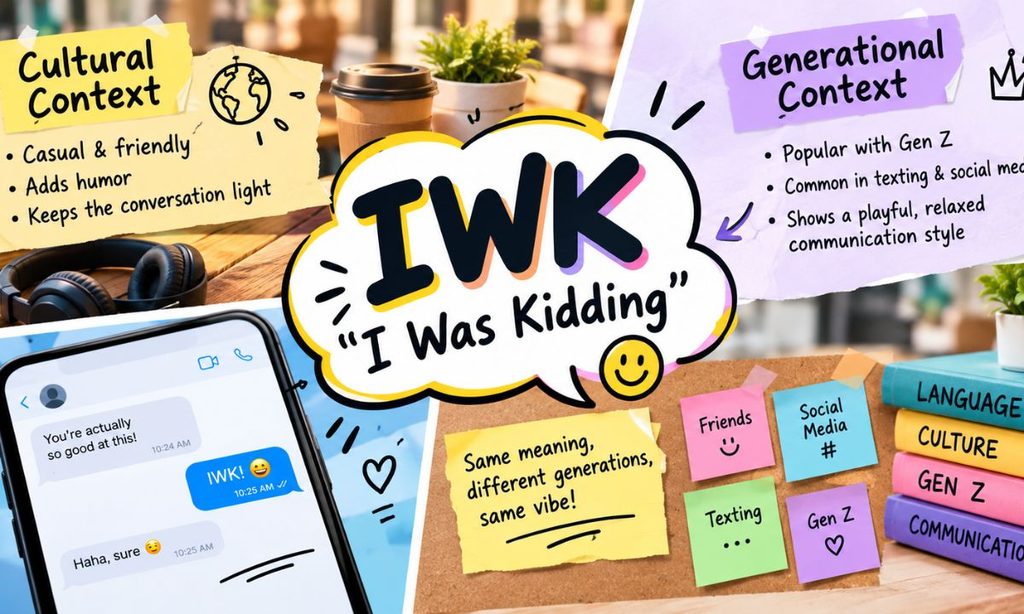
IWK fits into a broader texting habit of tacking short clarifier tags onto jokes, alongside terms like “jk” and “lol.” Because sarcasm and exaggeration read differently without tone of voice, younger digital-native texters tend to lean on these tags more heavily than older generations, who may rely more on context alone.
Why IWK Became Popular
The rise of hyperbolic, over-the-top texting style, especially among younger users, created a real need for a quick “not serious” tag. IWK filled that role alongside other joke-clarifiers, riding the same wave of meme culture where a dramatic statement is often immediately followed by a disclaimer.
Iwk meaning gen z
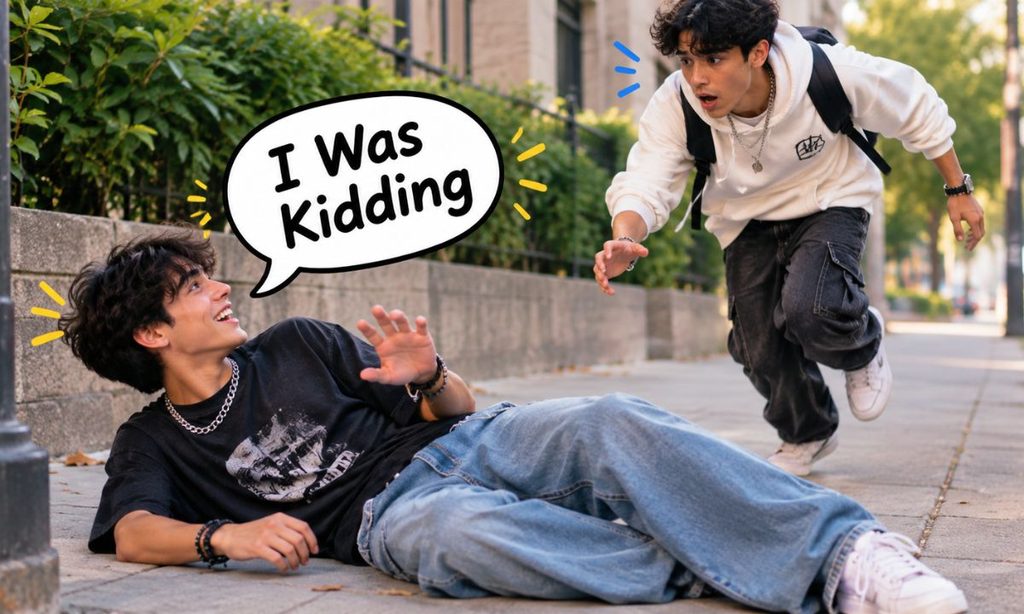
Among Gen Z texters, IWK functions similarly to “jk,” though it’s noticeably less common and less universally recognized. It tends to show up after intentionally exaggerated statements, often paired with a laughing emoji to reinforce the joke framing rather than leave any doubt.
Semantic Core Meaning Of IWK
Strip away the specific joke, and IWK always does the same job: it tells the reader not to take the previous statement at face value. It’s a small, after-the-fact disclaimer more than a standalone message.
Also Read This:DWU Meaning in Text: What Does DWU Mean & How to Use It?
Most Common IWK Meaning In Text (Deep Dive)
“I Was Kidding” is the meaning with the most consistent support across slang sources, though IWK overall is far less documented and far less universally recognized than comparable terms like JK. It typically shows up in these situations:
- Right after an exaggerated or over-the-top claim
- Following a surprising statement meant to get a reaction
- In playful teasing between friends
- Paired with a laughing or sweating emoji to reinforce the joke
Because the term isn’t as widely recognized as its close relatives, it’s common for some recipients to need a moment to place what it means, even when the surrounding context makes it fairly clear.
Meaning Based On Context
IWK’s meaning stays fairly consistent, but how clearly it reads depends on the setting.
| Context | Likely Meaning | Notes |
|---|---|---|
| Casual friend chat | I was kidding | Most common and clearest use case |
| After a dramatic or exaggerated claim | I was kidding | Classic joke-then-disclaim pattern |
| Gaming or niche chat communities | I would know (rare) | Thin support, treat with caution |
| Professional or work messages | Not typically used | Reads as unclear or unprofessional |
How IWK Is Used In Real Conversations
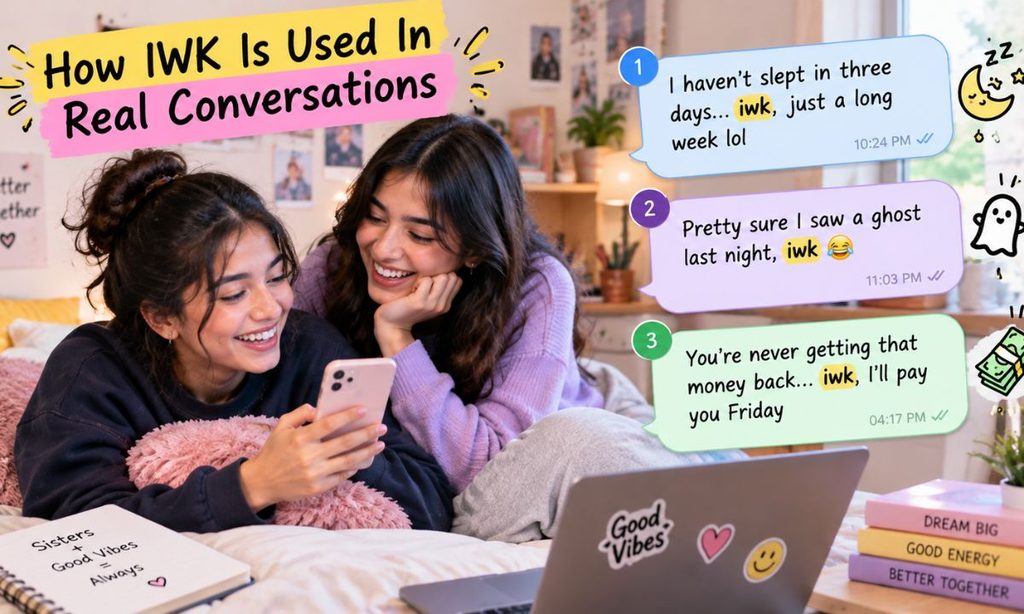
- “I haven’t slept in three days… iwk, just a long week lol” – softening an exaggerated claim
- “Pretty sure I saw a ghost last night, iwk 😂” – a playful, clearly joking statement
- “You’re never getting that money back… iwk, I’ll pay you Friday” – a teasing statement followed by reassurance
IWK Meaning On Different Platforms
| Platform | Typical Usage |
|---|---|
| Texting/iMessage | Follows an exaggerated statement as a quick disclaimer |
| Snapchat | Used in captions or replies after a joking claim |
| TikTok comments | Occasional use to soften a bold or sarcastic comment |
| Gaming chats | Used casually among friends, though less consistently defined |
| Instagram DMs | Similar to texting, clarifying a joking message |
When To Use Vs When To Avoid IWK
- Use it right after a statement that could genuinely be misread as serious
- Use it with people who already understand casual texting shorthand
- Avoid it in professional or unfamiliar conversations, since it’s not as widely recognized as JK
- Avoid relying on it alone in high-stakes conversations where a clearer explanation would prevent real confusion
Hidden Or Risky Meanings Of IWK
A couple of alternate meanings show up in scattered corners of the internet, though neither has strong cross-source support:
- I Would Know – appears in a small number of sources, used to express confidence about personal knowledge, but it’s not consistently documented enough to treat as an established meaning
- I Wonder / I Don’t Know – a loose variation seen on a few lower-quality slang pages, inconsistent with the more common “I was kidding” usage found elsewhere
Given how thin the documentation is overall for this term, “I was kidding” remains the safest default reading unless the surrounding context clearly points elsewhere.
Variations And Forms Of IWK
IWK almost always appears in lowercase (“iwk”) in casual texting, often paired with a laughing emoji like 😂 or 😅 to reinforce the joke. It doesn’t have many spelled-out or capitalized variations, unlike more established terms such as JK, which shows up consistently across both styles.
IWK Vs Similar Slang
| Term | Meaning | Notes |
|---|---|---|
| IWK | I was kidding | Less common, thinner documentation |
| JK | Just kidding | More universally recognized, near-identical meaning |
| LOL JK | Laughing, then clarifying it’s a joke | Adds emphasis to the joke framing |
| IDK | I don’t know | Different meaning, occasionally confused with IWK |
How To Decode The Correct Meaning
When IWK shows up and the meaning isn’t obvious, this quick check usually clears it up:
- Look at the statement right before it. A dramatic or exaggerated claim strongly points to “I was kidding.”
- Check for supporting emojis. A laughing or sweating emoji reinforces the joke reading.
- Consider the platform and relationship. Casual friend chats and gaming groups favor the joking meaning.
- If it’s still unclear, ask directly, since IWK isn’t universally recognized enough to assume everyone reads it the same way.
How To Respond To IWK
- Play along with a laugh or a short reply like “lol okay” to acknowledge the joke
- If the original statement genuinely worried you, it’s fine to say so rather than just moving past it
- No lengthy response is needed, IWK is meant to close the loop on a joke quickly
Common Misunderstandings About IWK
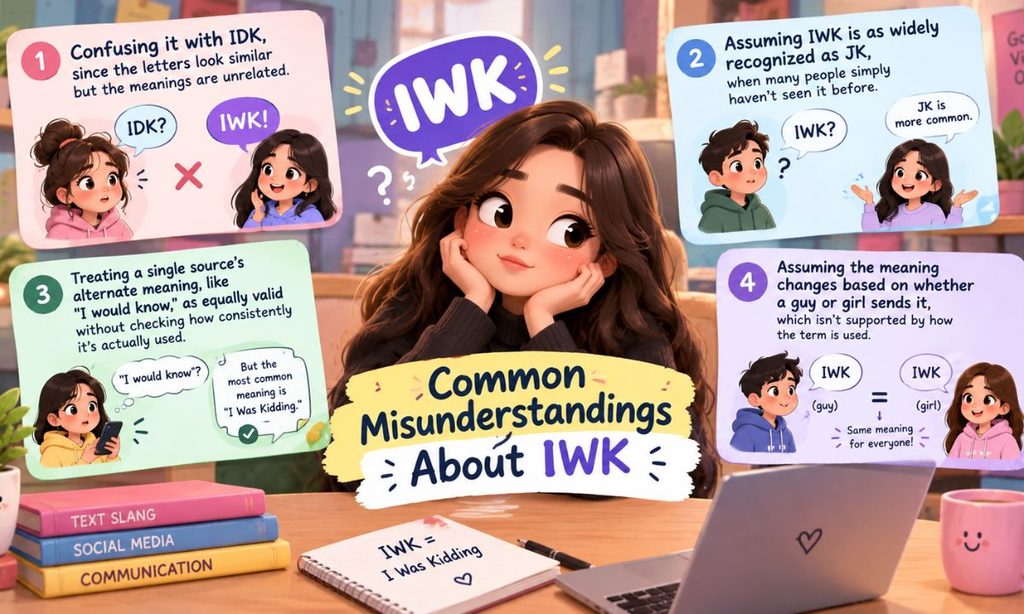
- Confusing it with IDK, since the letters look similar but the meanings are unrelated
- Assuming IWK is as widely recognized as JK, when many people simply haven’t seen it before
- Treating a single source’s alternate meaning, like “I would know,” as equally valid without checking how consistently it’s actually used
- Assuming the meaning changes based on whether a guy or girl sends it, which isn’t supported by how the term is used
Regional And Cultural Usage Of IWK
IWK shows up mostly in English-language casual texting circles, particularly among younger users on gaming platforms and social media. It hasn’t reached the same global recognition as more established slang terms, so outside of casual, English-heavy digital spaces, it’s far less likely to be understood without explanation.
Frequently Asked Questions
What does IWK mean in text?
It most commonly means “I was kidding,” used right after a joking or exaggerated statement to clarify that it wasn’t serious.
Is IWK the same as JK?
They mean nearly the same thing, but JK is far more widely recognized, while IWK is a less common variation of the same idea.
Does IWK ever mean something other than “I was kidding”?
A few sources list “I would know” or vaguer meanings, but these have much weaker support, so “I was kidding” remains the safest default interpretation.
Does IWK mean something different from a girl versus a boy?
No, the meaning stays the same regardless of who sends it. Tone depends on the relationship and context, not gender.
Is it okay to use IWK with someone who might not know texting slang?
It’s safer to spell out “just kidding” with people unfamiliar with casual shorthand, since IWK isn’t as universally recognized as terms like JK.
Conclusion
IWK is best understood as a quieter, less common cousin of “JK,” used to walk back an exaggerated or surprising statement so it reads as a joke rather than a serious claim. The documentation behind it is thinner than most texting slang, but “I was kidding” is consistently the strongest, most-repeated meaning.
When in doubt, the statement right before IWK, along with any emoji attached to it, will almost always tell you everything you need to know.



Pingback: EYP Meaning in Text: What Does EYP Mean in Chats & Social Media?