


A pet peeve is a small annoyance that bothers one person far more than it bothers most people. Chewing sounds, unanswered texts, and a crooked picture frame can all qualify, as long as the irritation is personal and a little out of proportion.
This guide explains what pet peeves are, where the phrase came from, and how people use it in conversation. It also covers how pet peeves differ from deal breakers and misophonia, how the phrase translates into Chinese and Tagalog, and whether it has a true opposite.
Pet Peeves – Quick Meaning
A pet peeve is something minor that a person finds especially irritating, often more than other people do. Wiktionary lists “pet hate” and “bugbear” as synonyms, and Wikipedia also records “pet aversion.”
- Personal: it reflects one person’s limits, not a universal rule.
- Minor: it is an irritation, not a serious offense.
- Recurring: it tends to bother the same person every time.
Origin & Background of the Term
The phrase appeared in the 1910s. Etymonline dates it to 1917 and explains that “pet” was used ironically for an especially cherished thing, while “peeve” is a back-formation from “peevish,” a word that goes back to the late 14th century. Grammarphobia, citing American Heritage, places the phrase around 1919, so exact dates vary slightly between references.
Wikipedia notes that a Chicago Tribune comic strip called The Little Pet Peeve, which ran from 1916 to 1920, helped bring the phrase to a wide readership. The humor lies in treating an annoyance as something you keep and feed, much like a pet.
Pet peeve in Chinese

Mandarin has no single fixed equivalent. A native speaker on italki explains that Chinese usually handles the idea with a verb such as 受不了 or 讨厌 inside the sentence. Wiktionary gives 讨厌的事情 (tǎoyàn de shìqíng), and Cambridge Dictionary translates its cleaning-the-bathroom example as 我最讨厌的事情就是打扫浴室.
- 讨厌的事情 (traditional: 討厭的事情): the most neutral wording, meaning “annoying thing.”
- 我最受不了…: “what I can’t stand most,” common in speech.
Some learner sites suggest 忌讳, but that word usually means a taboo, so it can mislead.
Real-Life Conversations (How People Actually Use It)
- “My biggest pet peeve is people who reply all to a company-wide email.”
- “It’s a pet peeve of mine when someone says they’re five minutes away and hasn’t left yet.”
- “This is a total pet peeve, so ignore me, but please don’t stack the dishes like that.”
- “What’s your pet peeve?” “Honestly? Loud typing.”
Speakers often admit their pet peeve is a bit unreasonable, which is part of how the phrase works. Comedian George Carlin turned that idea into a joke, saying he had no pet peeves, only major, psychotic hatreds.
Also Read This:What Does LDM Mean in Text? LDM Meaning, Slang Uses & Chat Examples (2026)
Emotional & Psychological Meaning
Pet peeves usually involve a quick flash of irritation tied to expectations about manners, noise, space, or time. When someone breaks an unwritten rule you care about, the reaction can feel bigger than the offense, which is why people say “I know it’s silly, but.”
Sound triggers are especially common, but misophonia is a separate matter. The term describes sudden, intense anger, panic, or disgust at specific sounds such as chewing, and how to classify it has been debated. If reactions feel overwhelming or disrupt daily life, a doctor or audiologist is a better next step than a list of pet peeves.
Usage in Different Contexts
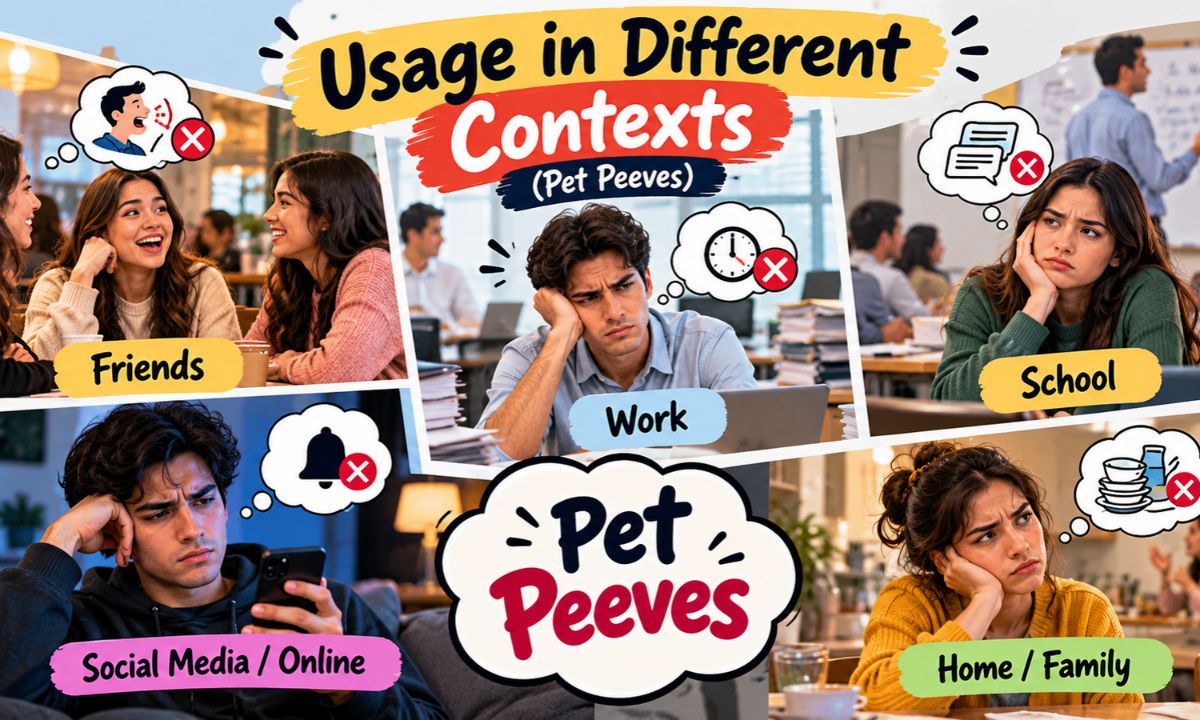
- Friendships and dating: a common get-to-know-you question that reveals habits and values.
- Workplace: late meetings, vague emails, or noisy open offices.
- Roommates and family: shared-space habits like dirty dishes or borrowed items.
- Job interviews: “What is your biggest pet peeve?” is best answered with a mild, work-related example.
Common Misunderstandings
- Widely disliked behavior is not a pet peeve. Grammarist points out that being annoyed by a dog barking all night is not a pet peeve, because nearly everyone would be.
- Serious problems do not qualify. Lying, cruelty, and unsafe driving are offenses, not peeves.
- “Pet” does not mean liked. The word is used ironically.
- It is not a phobia. A pet peeve irritates, while a phobia frightens.
Comparison Table
| Term | Meaning | Intensity | Example |
|---|---|---|---|
| Pet peeve | A personal, minor, recurring irritation | Low | Pen clicking |
| Annoyance | A general irritation that fades quickly | Low | Slow Wi-Fi |
| Red flag | A warning sign of a larger problem | Medium to high | Repeated lying |
| Deal breaker | An issue that ends a relationship or agreement | High | Refusing to compromise on core values |
| Misophonia | A strong emotional reaction to specific sounds | High | Panic at chewing sounds |
Pet peeve opposite

No dictionary lists a true one-word opposite. Merriam-Webster’s thesaurus offers antonyms such as pleasure, joy, and delight, and other thesauruses suggest passion, hobby, or favorite. The closest everyday idea is a small thing that delights you, like the sound of rain or a tidy desk.
Do not confuse this with “pet project” or “pet theory.” Cambridge Dictionary uses the same sense of “pet” there, meaning a favorite, which makes them relatives of the phrase rather than opposites.
Variations / Types of Pet Peeves
- Sound: loud chewing, pen clicking, speakerphone calls in public.
- Manners: interrupting, skipping thank-yous, ignoring greetings.
- Time: lateness and last-minute cancellations.
- Technology: reply-all emails, ignored messages, unmuted video calls.
- Language: misused words and grammar slips.
- Public space: slow walkers, blocked aisles, cutting in line.
How to Respond When Someone Uses “Pet Peeve”
Match the tone. A lighthearted mention deserves a light reply, while a heartfelt one deserves a listen.
- Casual: “Ha, noted. What’s yours?”
- When it involves you: “Thanks for telling me. I’ll try to remember that.”
- When you cannot change it: “I understand why that bugs you, but it’s hard for me to avoid.”
Regional & Cultural Usage

Cambridge Dictionary labels “pet peeve” as American English and gives “pet hate” as the equivalent, which is the form British speakers tend to use. Other languages have their own idioms, such as French “bête noire” and Danish “yndlingsaversion,” literally “favorite aversion.”
Culture shapes what counts as irritating. Punctuality, personal space, and wearing shoes indoors are judged differently around the world, so one person’s pet peeve may be someone else’s normal behavior.
Pet peeve in Tagalog
Filipino speakers often keep the English phrase, as in “Pet peeve ko talaga…” seen in social media captions. Tagalog does not appear to have a standard one-word equivalent, so people use descriptive wording.
- Pinakaayaw ko: “what I dislike most.”
- Nakakainis na bagay: “an annoying thing.”
- Ikinaiinis ko: “what annoys me.”
These come from Q&A and language-learning sites rather than dictionary entries, so treat them as everyday paraphrases.
Frequently Asked Questions About Pet Peeves
What does pet peeve mean in simple words?
It is a small thing that annoys you more than it annoys most people.
Where does the phrase pet peeve come from?
It dates to the 1910s and combines “pet,” meaning a cherished thing, with “peeve,” meaning to irritate. The pairing is ironic.
Is a pet hate the same as a pet peeve?
Yes, they are synonyms. “Pet hate” is the more British form, and “pet peeve” is the American one.
What is the difference between a pet peeve and misophonia?
A pet peeve is a mild irritation, while misophonia involves intense emotional reactions to specific sounds. Persistent or overwhelming reactions are worth discussing with a healthcare professional.
How do you answer “What is your biggest pet peeve?”
Pick a mild, relatable example such as people being late or chewing loudly. Avoid serious accusations or anything that sounds like a personality flaw.
Conclusion
A pet peeve is a minor, personal, recurring annoyance, and the phrase has been part of English since the 1910s. It sits below deal breakers and red flags, and it is different from misophonia. Whether you say it in English, Mandarin, or Tagalog, the idea stays the same: a small thing that gets under your skin.



Pingback: What Does ALR Mean in Text? ALR Meaning, Slang Uses & Examples (2026)
Pingback: What Does JOI Mean in Text? Meaning, Slang Uses & Examples (2026)