

Why This Gets Confusing
“SN” shows up in a lot of different places, from Snapchat usernames to a friend brushing off an apology to an old chat room habit that never fully died out. Unlike slang with one clear meaning, SN carries several genuinely common uses, and none of them dominates the way “lol” or “brb” does. That’s exactly why people get stuck staring at it mid-conversation.
This guide breaks down what SN actually means across the situations you’re most likely to run into it, how to tell which meaning applies, and where it doesn’t belong at all.
Does SN Mean Something Different From a Girl or a Guy?
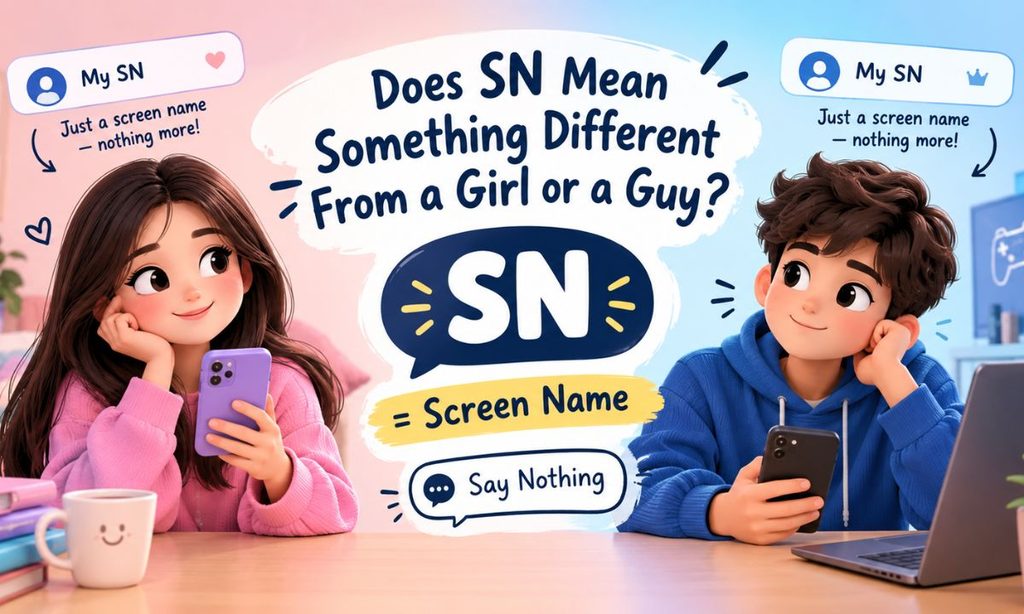
Some slang guides claim SN carries a softer, more emotional meaning when a girl sends it (like brushing off a compliment or shutting down an argument) and a more casual, reassuring meaning when a guy sends it (like “we’re good”). This framing shows up across several sites, but it doesn’t hold up as a real pattern.
What actually determines the meaning of SN is the conversation it appears in, not the gender of the person typing it. A message like “SN” right after someone explains themselves during an argument reads as “say nothing” regardless of who sent it. A message like “what’s your SN” during a gaming or social media conversation reads as “screen name” regardless of who sent it. Reading gender into it skips the context that’s actually doing the work.
What It Really Means When Someone Uses It
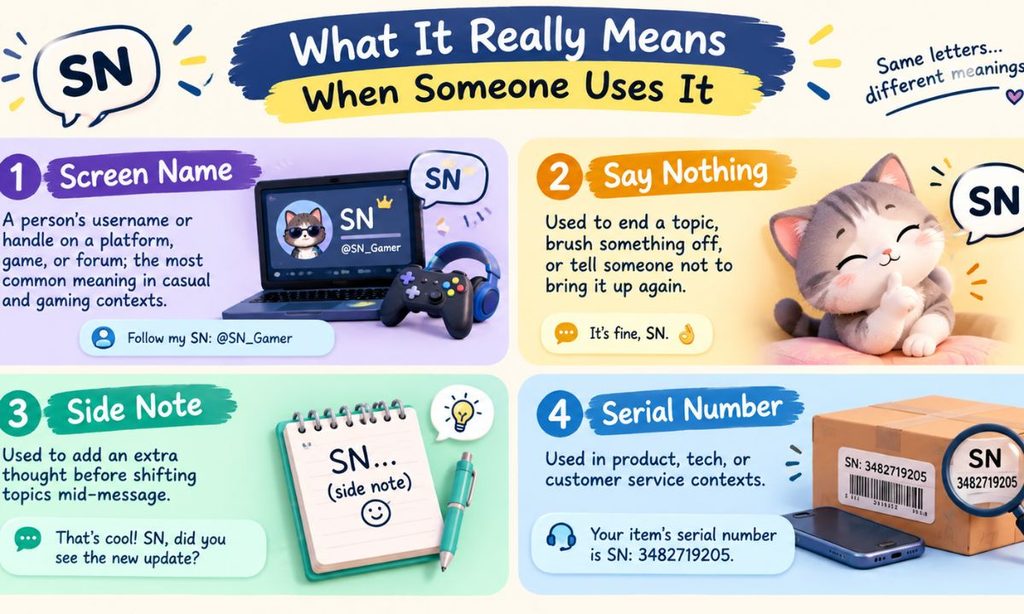
SN doesn’t have one fixed definition. Depending on where you see it, it most commonly points to one of these:
- Screen Name — a person’s username or handle on a platform, game, or forum; the most common meaning in casual and gaming contexts
- Say Nothing — used to end a topic, brush something off, or tell someone not to bring it up again
- Side Note — used to add an extra thought before shifting topics mid-message
- Serial Number — used in product, tech, or customer service contexts
Less common but still real: in nursing and hospital scheduling contexts, “SN” stands for Student Nurse. In older or formal writing, “s.n.” is Latin shorthand for “sine nomine,” meaning “without a name,” used when a publisher or author isn’t listed. Neither of these has anything to do with texting slang, but they explain why SN sometimes turns up in unexpected places.
The “screen name” meaning is the oldest of the bunch. It traces back to early instant messaging services and chat rooms in the 1990s and 2000s, where every user picked a “screen name” to identify themselves instead of using a real name. That habit carried over into gaming and social platforms, which is why SN still shows up most naturally in gaming chats today. “Say Nothing” and “Side Note” are newer, more conversational uses that developed separately as texting shorthand, which is part of why the same two letters can point in such different directions depending on when and where you learned them.
How It Shows Up in Real Conversations
The surrounding words usually make the intended meaning obvious. If SN comes right after someone asks for an account or username, it’s a screen name request. If it follows an apology, an excuse, or a tense back-and-forth, it’s almost always “say nothing.”
- A request for a username almost always signals “Screen Name”
- A response to an apology or explanation almost always signals “Say Nothing”
- A message inserted mid-thought, followed by a topic shift, usually signals “Side Note”
- A message tied to a product, order, or device usually signals “Serial Number”
Also Read This:What Does TMP Mean in Text? Meaning, Uses & Common Mistakes
When the Meaning Changes Based on Who’s Talking
Beyond the message content itself, the relationship between the two people shapes how SN lands.
| Sender Relationship | Likely Reading |
|---|---|
| Close friend after a small mistake | Casual, reassuring “it’s fine, drop it” |
| Someone you’re mid-argument with | Colder, “I don’t want to hear it right now” |
| Gamer or online acquaintance | Almost always “screen name” |
| Coworker in a group chat | Often “side note,” adding a small extra point |
Tone gets lost easily in text, so a message meant to sound chill can come across as cold if there’s no other context around it.
Times You Should Skip Using SN
SN is casual shorthand, and it doesn’t always translate well outside of relaxed conversations.
- Work emails or professional messages, where it reads as vague or dismissive
- Serious conversations where “say nothing” could come across as shutting someone down rather than reassuring them
- Messages to people unfamiliar with texting slang, who may not recognize the abbreviation at all
- Situations where clarity matters more than brevity, like logistics, plans, or anything that needs a real answer
Other Ways to Say the Same Thing
If you want the same message without relying on an abbreviation that can be misread, these work well depending on which meaning you’re going for.
- Instead of “Say Nothing”: “It’s fine, don’t worry about it,” “Let’s just drop it”
- Instead of “Screen Name”: “What’s your username,” “What should I add you as”
- Instead of “Side Note”: “Quick side thought,” “Also, just so you know”
- Instead of “Serial Number”: “What’s the serial number on that,” “Can you send the SN off the device”
What These Texts Actually Look Like
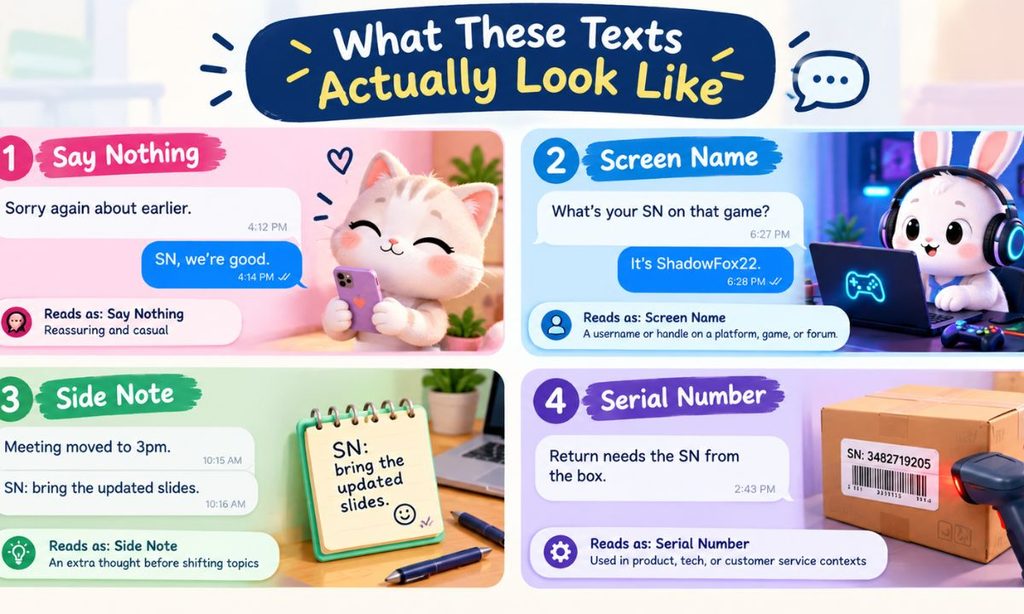
- “Sorry again about earlier.” “SN, we’re good.” — reads as “say nothing,” reassuring and casual
- “What’s your SN on that game?” “It’s ShadowFox22.” — reads as “screen name”
- “Meeting moved to 3pm. SN: bring the updated slides.” — reads as “side note”
- “Return needs the SN from the box.” — reads as “serial number”
In each case, the meaning is clear within a few words of context, not from the abbreviation alone.
Where You’ll See It Most
| Platform or Setting | Typical Meaning |
|---|---|
| Gaming chats and forums | Screen Name |
| Texting between friends | Say Nothing |
| Group chats and casual work chats | Side Note |
| Customer service or product support | Serial Number |
| Nursing and hospital scheduling | Student Nurse |
Why People Get It Wrong
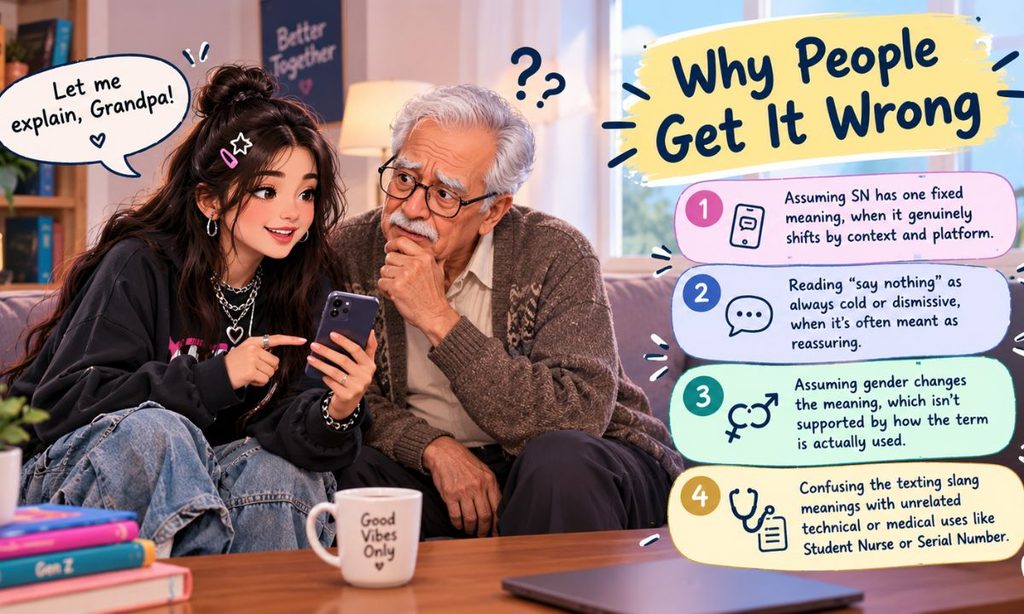
- Assuming SN has one fixed meaning, when it genuinely shifts by context and platform
- Reading “say nothing” as always cold or dismissive, when it’s often meant as reassuring
- Assuming gender changes the meaning, which isn’t supported by how the term is actually used
- Confusing the texting slang meanings with unrelated technical or medical uses like Student Nurse or Serial Number
Frequently Asked Questions
What does SN mean in a text message?
It most often means “Screen Name” or “Say Nothing,” depending on what the conversation was about right before it appeared.
Does SN mean something different from a girl versus a guy?
No. The meaning depends on the conversation’s context, not the sender’s gender, despite some slang guides claiming otherwise.
Is “SN” rude when used to end a conversation?
Not usually. It’s typically meant as a casual way to say “let’s drop it,” though tone and relationship can make it read as colder in an argument.
What does SN mean in a medical or professional setting?
In nursing contexts it usually stands for Student Nurse, and in older formal writing “s.n.” is Latin for “without a name” (sine nomine), both unrelated to texting slang.
Should I use SN in a work message?
It’s better avoided in professional settings since it’s ambiguous; writing out “quick side note” or “let’s drop it” communicates the same thing more clearly.
The Bottom Line
SN doesn’t have a single meaning, and that’s the whole reason it trips people up. Reading the message around it, rather than the two letters alone, is the fastest way to know whether someone’s asking for a username, brushing something off, adding a quick thought, or referencing something technical. Once you get used to spotting those context clues, decoding SN becomes automatic.



Pingback: What Does HMJ Mean in Text? Meaning, Uses & Examples