

Why You’re Probably Here
Someone sent you “TMP” and the context didn’t make it obvious. Maybe it came from a friend mid-conversation, a stranger on a dating app, or a coworker in a Slack thread, and now you’re stuck trying to figure out what three letters are supposed to mean. That confusion is normal. TMP is one of those texting abbreviations that never settled on a single agreed-upon meaning, which is exactly why it trips people up.
This guide covers what TMP actually means across the different places you’ll see it, how tone and platform change the reading, and where the term does not belong at all.
What It Actually Means in Real Life
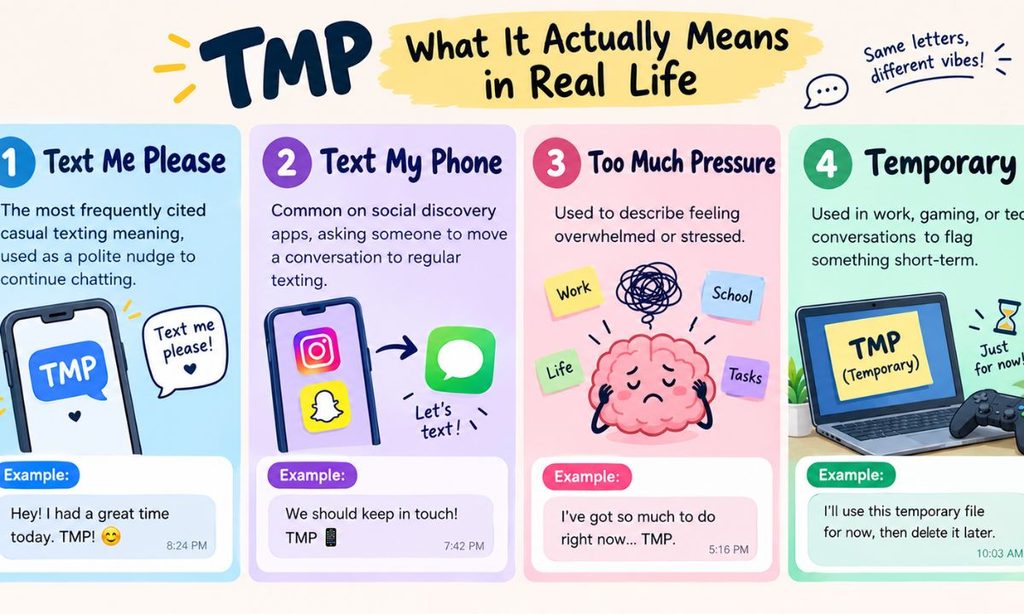
TMP does not have one official, universally agreed meaning. The most commonly claimed definition in casual texting is “Text Me Please,” used as a soft request to keep a conversation going. But it competes with several other claimed meanings that show up just as often depending on who you ask:
- Text Me Please — the most frequently cited casual texting meaning, used as a polite nudge to continue chatting
- Text My Phone — common on social discovery apps, asking someone to move a conversation to regular texting
- Too Much Pressure — used to describe feeling overwhelmed or stressed
- Temporary — used in work, gaming, or tech conversations to flag something short-term
None of these is an “official” definition in the way a dictionary entry would be. They’re all community usage that spread through repetition, which is normal for texting slang, but it does mean you genuinely have to rely on context rather than assuming one fixed meaning applies everywhere.
How People Use It in Everyday Situations
The clearest way to figure out which meaning applies is to look at how TMP functions in the sentence. If it works like an instruction, it’s probably a request. If it works like a noun or a feeling, it’s probably describing a state.
- “Busy right now, TMP tonight” — functions as a request, reads as “text me please”
- “This week has been TMP” — functions as a description, reads as “too much pressure”
- “This fix is TMP until we ship the real one” — functions as a label, reads as “temporary”
- “Can’t talk on here, TMP” — functions as a request to switch platforms, reads as “text my phone”
Sentence structure does most of the work here. An instruction-shaped sentence points toward a request. A feeling-shaped sentence points toward an emotional or descriptive meaning.
Tone & Context (This Is Where It Gets Tricky)
TMP doesn’t carry a fixed emotional tone on its own, which is part of why it causes mix-ups. The same three letters can read as casual, mildly urgent, or even a little pushy depending on what surrounds them.
| Signal | Likely Reading |
|---|---|
| Sent with a lowercase, no punctuation, mid-conversation | Casual, low-stakes nudge to keep talking |
| Sent after a long silence with no follow-up | Could read as slightly demanding |
| Paired with an emoji or a joke | Playful, not serious |
| Standalone with no other context | Ambiguous, genuinely hard to read without more information |
If you’re unsure which way a message was meant, the safest move is usually to ask rather than guess, especially in a newer relationship or a professional exchange.
Does TMP Mean Something Different From a Girl?
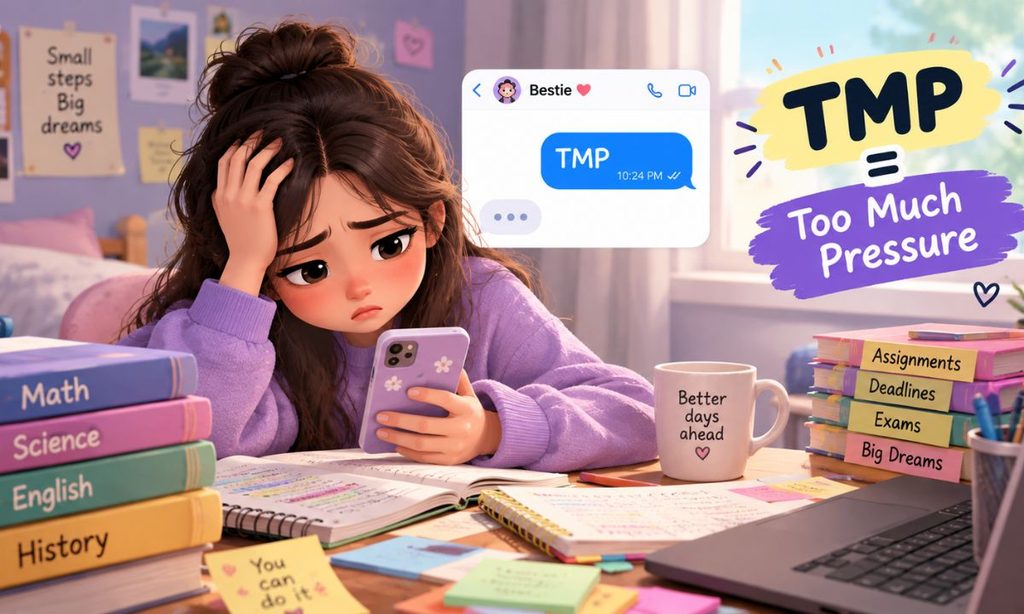
Some slang guides claim TMP carries a more “emotional” meaning, leaning toward “Too Much Pressure,” when it’s sent by a girl, as opposed to a more literal or transactional meaning when sent by a guy. This claim shows up inconsistently across sources, and it does not hold up as a real linguistic pattern.
The letters TMP do not change meaning based on who is sending them. What actually determines the meaning is the same thing that determines it in any text: the sentence structure, the relationship between the two people, the platform, and what was said immediately before it. Treating gender as the deciding factor skips over the context that’s actually doing the work, and it can lead you to misread a message based on an assumption rather than what was actually written.
When You Should NOT Use This Term
TMP is casual shorthand, and it doesn’t translate well into settings that call for clarity or professionalism.
- Work emails or messages to a boss, where it reads as unclear and unprofessional
- First messages to someone you’ve never spoken with, where an unexplained acronym can come across as low-effort
- Serious or sensitive conversations, where ambiguity is the last thing you want
- Messages to people who aren’t familiar with texting slang, including many older relatives or professional contacts
If the situation calls for a clear ask, write it out: “Can you text me when you’re free?” removes all the guesswork that “TMP” introduces.
Also Read This:WYO Meaning in Text: What Does WYO Mean in Chat, Snapchat & Social Media?
Natural Alternatives (Grouped by Tone)
If you want the same message without relying on an ambiguous acronym, these work well depending on the tone you’re going for.
- Casual: “Text me later,” “Hit me up,” “Lemme know”
- Neutral/professional: “Let me know when you’re free,” “Please follow up by text”
- Describing stress: “This week is a lot,” “I’m overwhelmed right now”
- Flagging something short-term: “This is just a temporary fix,” “Placeholder for now”
Real-Life Examples
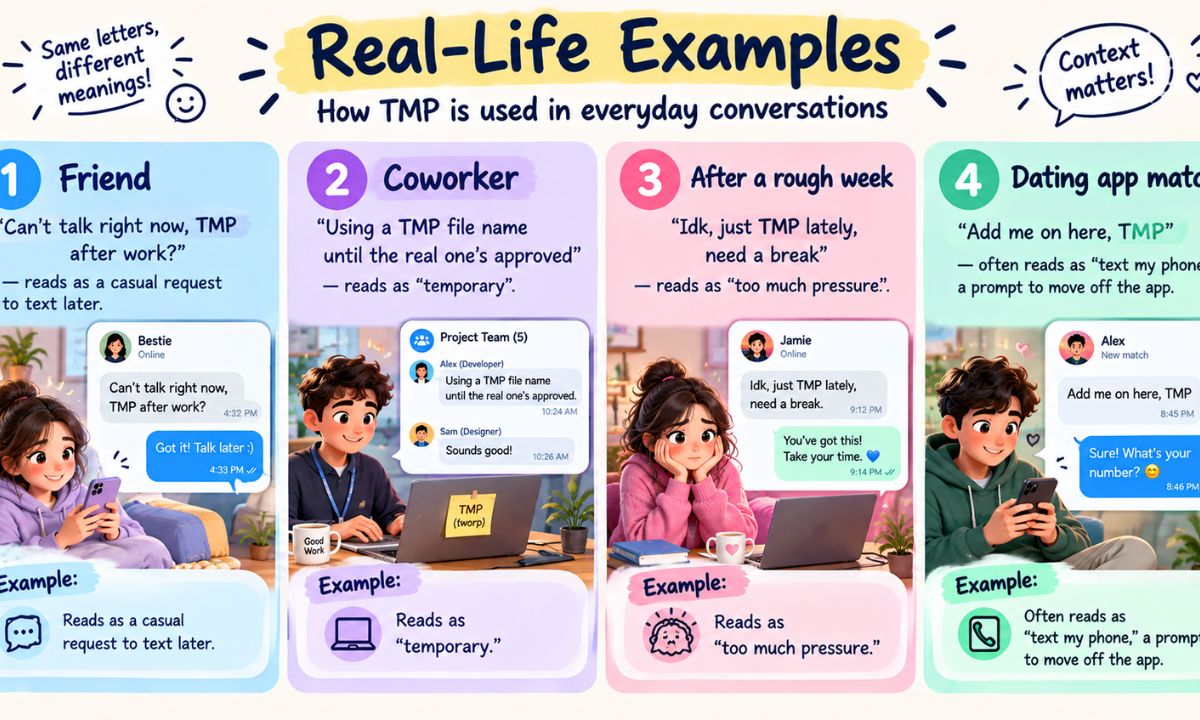
- Friend: “Can’t talk right now, TMP after work?” — reads as a casual request to text later
- Coworker in a group chat: “Using a TMP file name until the real one’s approved” — reads as “temporary”
- Text after a rough week: “Idk, just TMP lately, need a break” — reads as “too much pressure”
- Dating app match: “Add me on here, TMP” — often reads as “text my phone,” a prompt to move off the app
In every case, the surrounding words carry more information than the acronym itself.
Platform or Culture Notes
| Platform | Typical Reading | Notes |
|---|---|---|
| Texting (SMS/iMessage) | Text Me Please | Most common casual reading |
| Snapchat | Text Me Please / Temporary | Disappearing content makes the “temporary” reading plausible too |
| Social discovery apps | Text My Phone | Common prompt to move a conversation off-app |
| Work chats (Slack, Teams) | Temporary | Used to label drafts, fixes, or placeholders |
| Gaming/tech communities | Temporary | Refers to short-term files, accounts, or setups |
Common Misunderstandings
- Assuming TMP always means “Text Me Please” — it’s the most common casual reading, not a guaranteed one
- Confusing TMP with TMI (“Too Much Information”) — they look similar in passing but mean unrelated things
- Overlooking the computing use of “tmp,” short for temporary file, a term operating systems use for data that gets deleted after a task finishes
- Assuming gender changes the meaning, which isn’t supported by how the term is actually used
What Does TMP Mean in Medical Contexts?
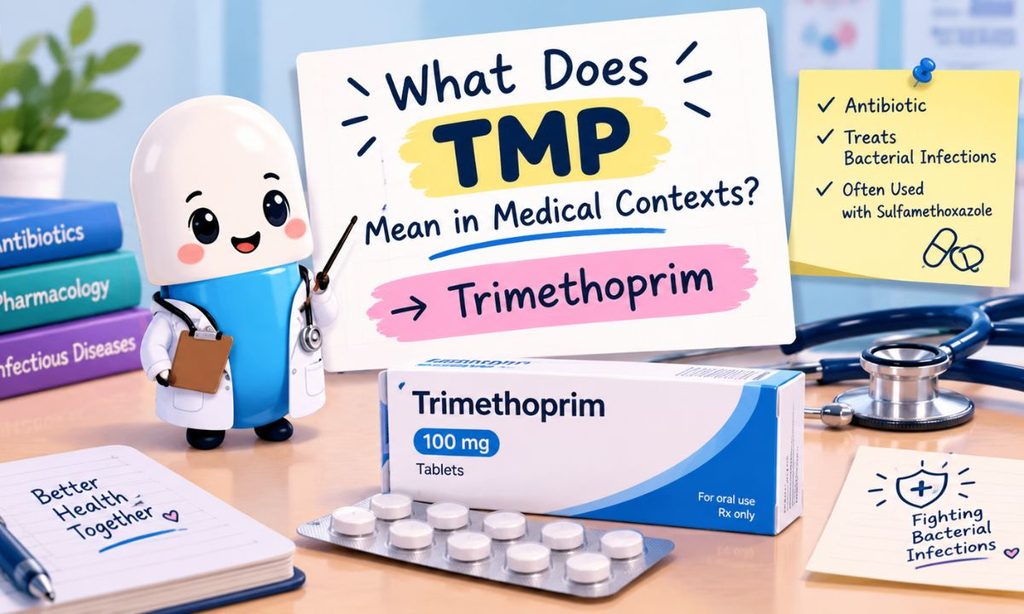
Outside of texting, TMP has a well-established, specific meaning in medicine: Trimethoprim, an antibacterial medication. Trimethoprim works by inhibiting an enzyme bacteria need to produce folate, which stops the bacteria from growing.
It’s frequently prescribed in combination with sulfamethoxazole, a pairing abbreviated as TMP-SMX and sold under brand names like Bactrim. This combination is commonly used to treat urinary tract infections, respiratory infections, and certain infections in people with weakened immune systems. Because trimethoprim can interact with other medications and carries specific dosing considerations, it should only be used under a doctor’s guidance rather than based on anything read online, including this article.
This medical meaning has nothing to do with the texting slang use. If you see “TMP” on a prescription bottle, in a medical chart, or in a doctor’s note, it’s almost certainly referring to the antibiotic, not a text message shorthand.
Frequently Asked Questions
What does TMP mean in a text message?
It most commonly means “Text Me Please,” though it can also mean “Text My Phone,” “Too Much Pressure,” or “Temporary” depending on context.
Does TMP mean something different when a girl sends it?
No. The meaning depends on sentence structure and context, not on the sender’s gender, despite some slang guides claiming otherwise.
What does TMP mean in a medical context?
TMP stands for Trimethoprim, an antibiotic commonly prescribed with sulfamethoxazole to treat infections like UTIs.
Is TMP the same as TMI?
No. TMP and TMI look similar but are unrelated; TMI stands for “Too Much Information.”
Should I use TMP in a work message?
It’s best avoided in professional settings since it’s ambiguous and reads as informal; a direct phrase communicates the same thing more clearly.



Pingback: What Does SN Mean in Text? Meaning, Uses & How Context Changes It