


The evil eye symbol is a protective amulet, most often a blue and white eye, worn or displayed to guard against the evil eye. The evil eye itself is a belief that an envious or malevolent glare can bring bad luck, illness, or harm. So the symbol is not evil. It is the shield, not the curse.
Amulets against the evil eye date back about 5,000 years, and the belief appears across the Mediterranean, West and South Asia, Africa, the Caribbean, and Latin America. The symbol also shows up today on jewelry, doors, cars, and boats.
This guide explains what the symbol means, where it came from, how protection works in different cultures, what the colors do and do not tell you, and how to use it respectfully.
What Does the Evil Eye Symbol Mean? – Quick Meaning
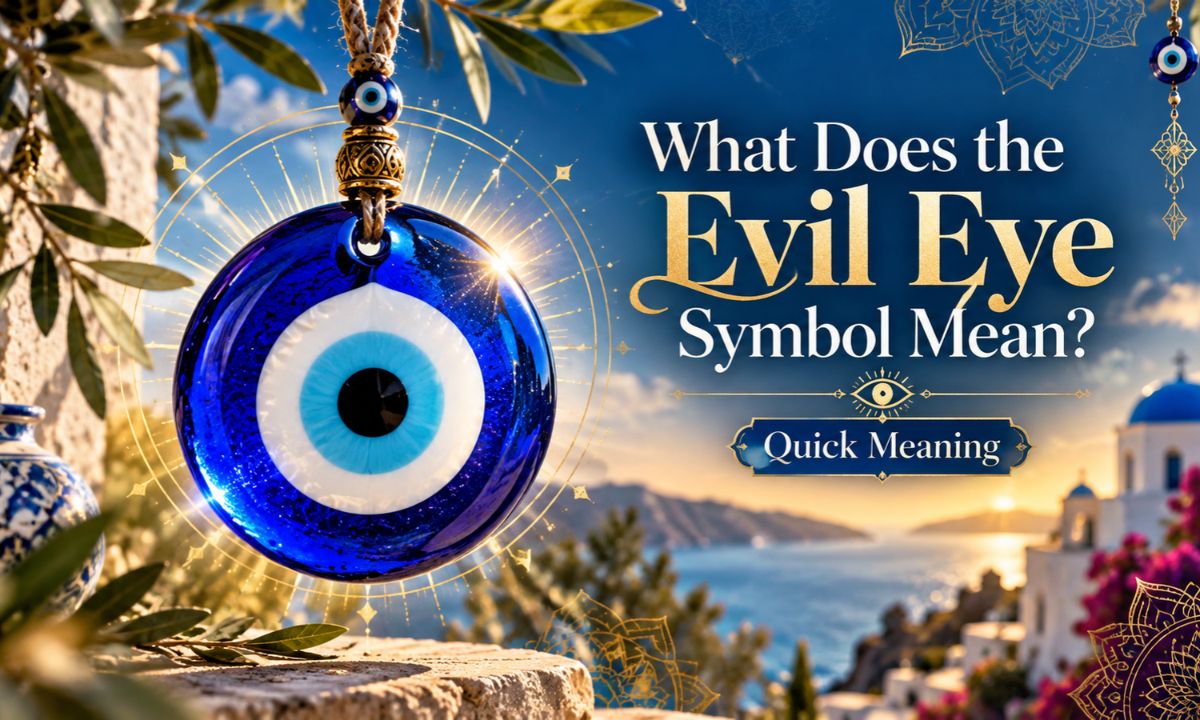
The evil eye symbol means protection from envy, jealousy, and the harm that a hostile or admiring glance is believed to cause. The eye is thought to look back at the gaze and turn it away.
- Common forms: the nazar bead (Turkish: nazar boncuğu), the hamsa hand, and eye motifs on jewelry and buildings
- Local names: nazar (Turkish), mati (Greek), ayin hara (Hebrew), al-ayn (Arabic), drishti (Indian languages), mal de ojo (Spanish)
- Main purpose: protecting people, children, homes, vehicles, and good fortune
- Status: a folk and religious belief, with no scientific evidence that a glance causes harm
Origin & Background
The idea is ancient. Texts from Ugarit, a Syrian port city that existed until about 1180 BC, describe the evil eye, and Greek writers from Hesiod to Plutarch refer to it. The Romans used protective charms called fascina, from the Latin verb that gave English the word “fascinate.”
Eye beads spread widely after glass beadmaking developed in the Mediterranean around 1500 BC. The word nazar comes from Arabic and means a look or glance.
One popular claim needs care. The alabaster “eye idols” from Tell Brak in Mesopotamia are often presented as the first evil eye symbols, but the Metropolitan Museum of Art describes them as unrelated to evil eye belief. They are better read as votive figures.
Evil eye protection
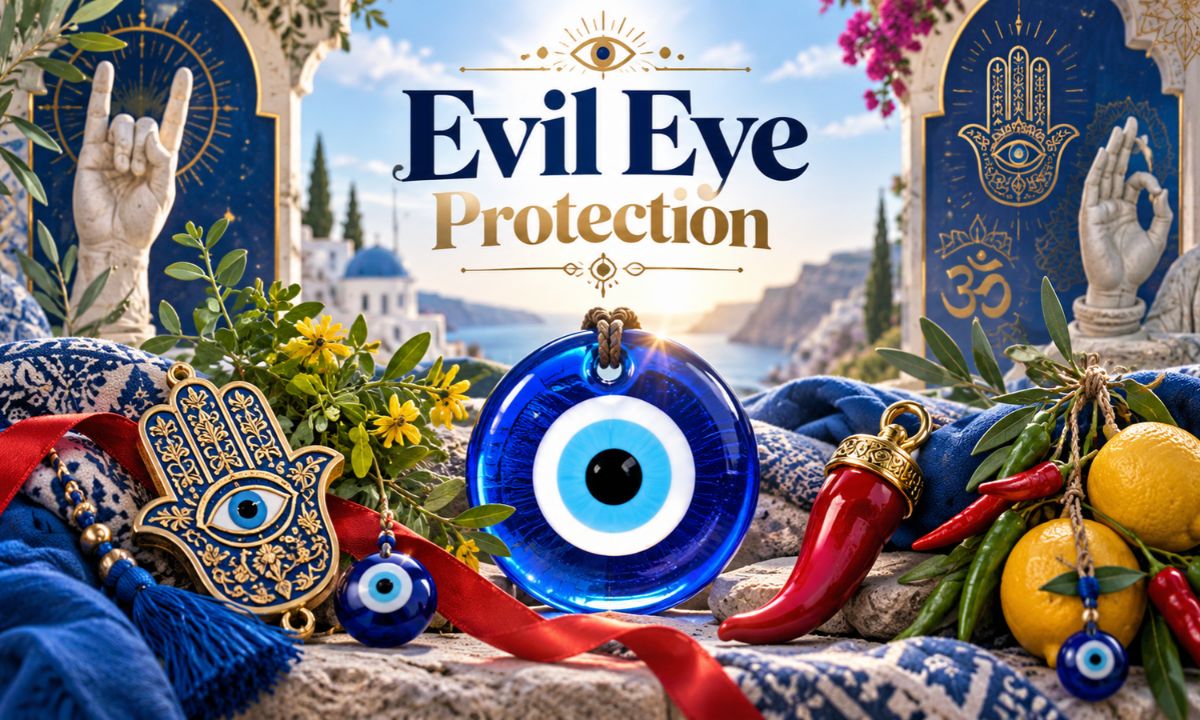
Protection works through objects, words, and actions. The shared aim is to deflect envy or to bless what is admired.
- Amulets: the nazar bead, the hamsa, and the Italian cornicello horn
- Protective phrases: “mashallah” in Arabic after a compliment, and “kinehore” or “b’li ayin hara” in Jewish tradition
- Gestures: symbolic spitting in Greek and Jewish custom, and the horned hand in Italy
- Plants and household items: rue in Iran and Palestine, and chilies and lemons in India
- Color and cloth: red ribbons in parts of South America, and blue in Trinidad and Tobago
Real-Life Conversations
These examples show how the belief appears in everyday speech.
- A relative admires a baby and adds “mashallah” so the compliment does not attract the evil eye.
- A Greek speaker says “ftou, na mi se matiaxo” after praising someone, meaning “I spit so I won’t give you the evil eye.”
- After good news, someone says “kinehore” to avoid tempting fate.
- A friend gives a nazar for a new home, a new baby, or a new car.
- In plain English, “she gave me the evil eye” just means she glared.
Emotional & Psychological Meaning
At its core, the evil eye is a folk theory of envy. It gives people a way to talk about the discomfort of being noticed, praised, or compared, and about the fear that good fortune might attract resentment.
Rabbi Abraham Isaac Kook described the evil eye as the harm done by feelings of jealousy and envy. Seen this way, the amulet works as reassurance and as a reminder to stay humble and generous. That is an interpretation of how the belief functions, not evidence that it works.
Evil Eye Bracelet

An evil eye bracelet is the most common modern form. It carries the same protective purpose as other amulets, worn on the wrist, ankle, or as a charm. In Mexico and Central America, infants are traditionally given amulet bracelets, often with an eye-like spot, and in Puerto Rico azabache bracelets serve a similar role.
Colors are a modern retail convention. Sellers assign meanings such as calm for dark blue or energy for red, but these lists vary by seller and have no traditional standard, so treat them as personal symbolism.
Also Read This:What Does IIRC Mean in Text? Meaning, Uses & Examples (2026)
Usage in Different Contexts
| Context | How the Symbol Is Used |
|---|---|
| Home | Hung near the door or inside rooms to guard the household |
| Vehicles and boats | Placed on cars, bus bumpers, and boat prows, such as Malta’s luzzu |
| Babies and children | Pinned to clothing or given as a first gift in some cultures |
| Jewelry and fashion | Worn as a bracelet, necklace, or ring, often as a style choice |
| Gifts | Given for new homes, births, and new beginnings |
When NOT to Use It
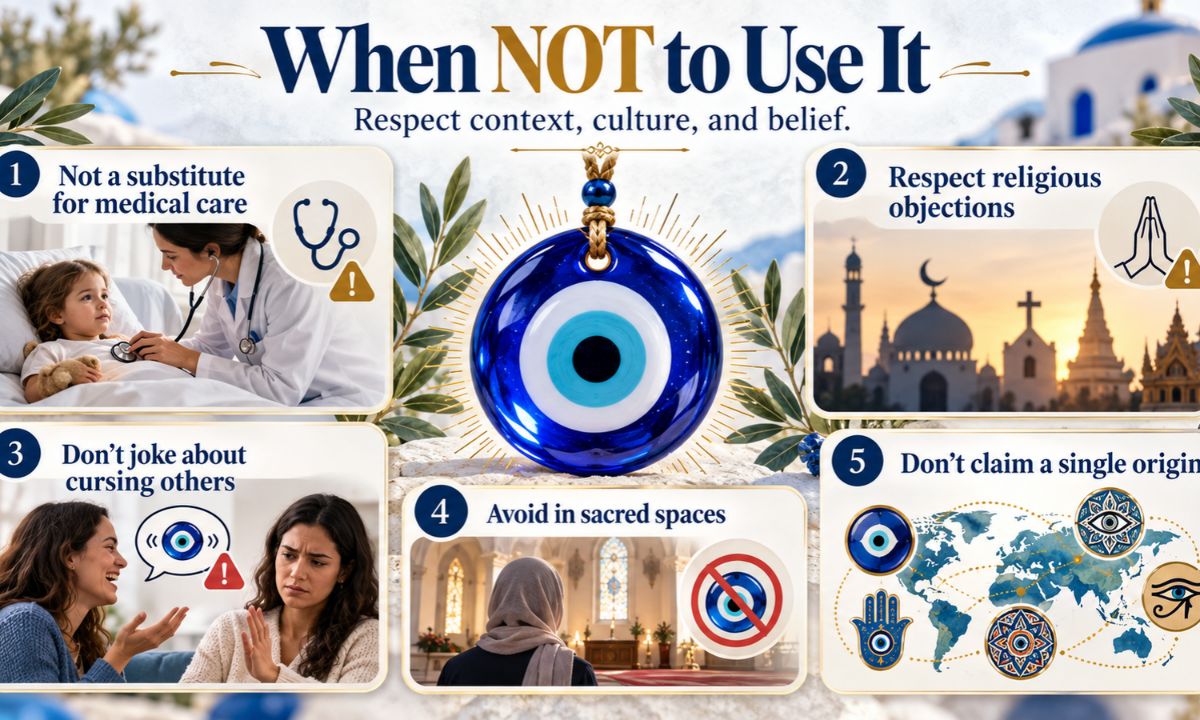
- As a substitute for medical care: a sick child needs a doctor, whatever the folk explanation.
- Around people who object on religious grounds: some Muslim authorities, including Turkey’s religious authority in 2021, have denounced evil eye charms as superstition.
- As a joke about cursing others: in cultures where the belief is serious, it can offend.
- In sacred spaces: avoid placing it in a place of worship without understanding local custom.
- With a claim of one national origin: several cultures share the symbol, so avoid presenting it as only Greek or only Turkish.
Common Misunderstandings
- “The symbol is the curse.” It is the protection against the curse.
- “It is only Turkish or Greek.” Both traditions are strong, but the belief is far older and wider.
- “Tell Brak eye idols prove it began there.” The Met says they are unrelated to the belief.
- “It is the same as the Eye of Horus.” The Egyptian symbol stands for protection and health, while the evil eye talisman specifically turns away malevolent gazes.
- “Every color has an official meaning.” Color meanings come mostly from modern sellers.
What does the evil eye mean spiritually

Spiritual meanings depend on the tradition. In Islam, belief in the evil eye is based on a saying of the Prophet Muhammad recorded in Sahih Muslim, and the recommended defense is reciting a blessing such as “mashallah,” not wearing charms. In Jewish thought, the evil eye is tied to envy, and a “good eye” means goodwill toward others.
Greek Orthodox sources treat envy as a spiritual sickness, and early church fathers such as John Chrysostom rejected the idea that the eye itself can physically injure. In Hindu practice, rituals like nazar utarna remove the effect of too much admiration. Outside religious frameworks, many people use the symbol for personal protection and good luck.
Comparison Table
| Symbol | Form | Main Region | Purpose |
|---|---|---|---|
| Nazar | Blue and white eye bead | Turkey, Greece, Balkans, West Asia | Reflects the evil eye |
| Hamsa | Hand, often with an eye | Middle East, North Africa | Protection and blessing |
| Cornicello | Twisted horn | Southern Italy | Warding off the malocchio |
| Azabache | Black or red amulet bracelet | Puerto Rico | Protecting infants |
| Eye of Horus | Stylized eye | Ancient Egypt | Protection, health, and luck |
How to Respond When Someone Uses It
- If someone adds “mashallah” or “kinehore”: a simple “thank you” is enough.
- If someone gives you a nazar: accept it warmly, since it is a gesture of care.
- If someone worries they have the evil eye: listen respectfully, and encourage a doctor’s visit for real symptoms.
- If you disagree with the belief: you can decline politely without mocking it.
Regional & Cultural Usage
- Turkey and Greece: nazar beads and mati charms are everyday objects, and Greek newborns are often given one early on.
- Arab and Muslim-majority regions: al-ayn is a recognized belief, with “mashallah” as the usual safeguard.
- South Asia: drishti or nazar is countered with chilies, salt, lemons, and ritual circling.
- Italy and Malta: the malocchio and horn amulets, and eye-painted fishing boats.
- Latin America and the Caribbean: mal de ojo is tied especially to infants, and Spain is the source of the belief there. Trinidad and Tobago uses the terms maljo and najar.
- Africa: buda in Ethiopia and thiat in Senegal show local versions.
Surveys show the belief is still widespread. Pew Research found majorities in 20 of 39 Muslim-majority countries surveyed in 2012, and a 2015 Pew survey in Central and Eastern Europe reported a median of 48 percent, with 66 percent in Greece.
Is the evil eye good or bad
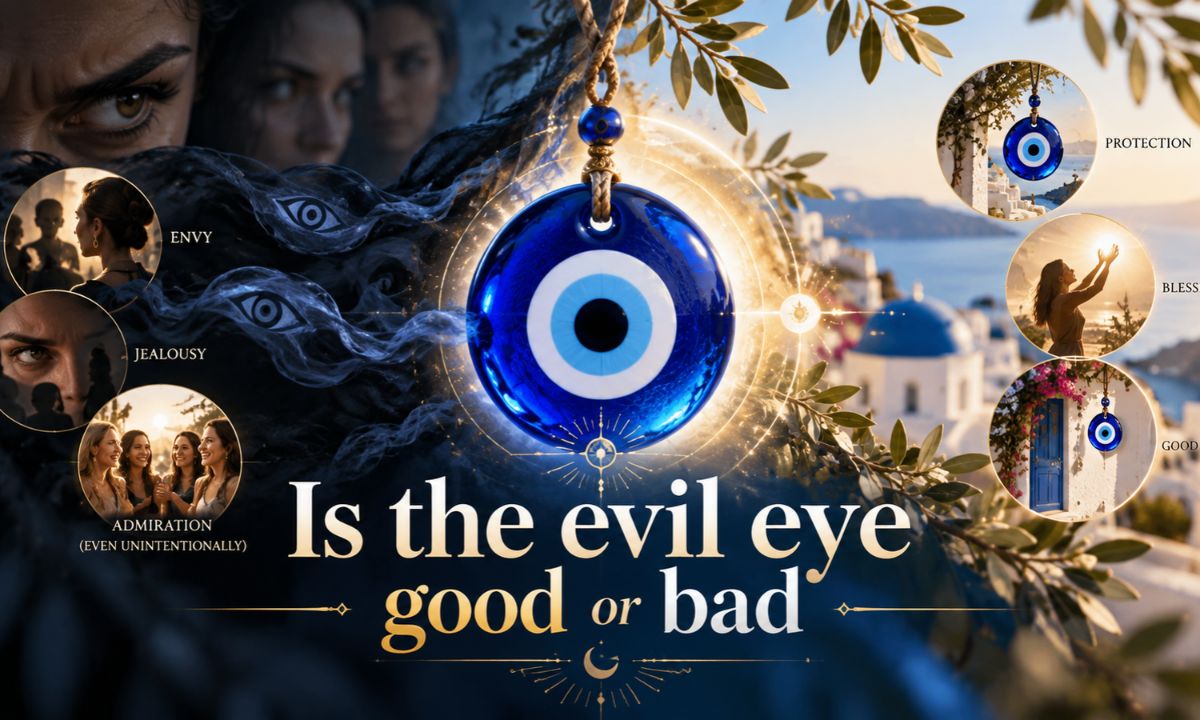
The evil eye as a curse is considered harmful, but the evil eye symbol is considered good because it protects. Many traditions also say the curse is often unintentional, caused by admiration as much as malice. That is why compliments are paired with a blessing, and why the amulet is usually seen as a friendly guardian.
Is It Safe for Kids?
The symbol is widely given to infants and children in many cultures, and it is harmless as a design. The real risk is the object. Small beads, loose cords, and bracelets can be choking or strangulation hazards, so avoid them in cribs and during sleep. Safer options include well-secured pieces worn only under supervision, or larger charms attached to clothing or a stroller.
Folk remedies for the evil eye, such as egg rubbing or oil tests, should never replace medical care for a sick child.
Frequently Asked Questions
What does the evil eye symbol mean?
It means protection against envy and the harm a hostile or admiring glance is believed to cause. The symbol is a shield, not a curse.
Is the evil eye Greek or Turkish?
Both traditions use it heavily, but the belief is much older and spread across many regions. The Turkish nazar and the Greek mati are regional forms of a shared idea.
Which hand should I wear an evil eye bracelet on?
There is no documented rule, so wear it wherever is comfortable. Personal preference is the standard.
What does it mean if an evil eye bead breaks?
Folk belief often says the amulet absorbed negative energy, as with Senegalese cowrie bracelets that darken and break. This is a tradition, not a proven effect.
Is it okay to wear one if I am not from the culture?
Many people do, and sellers promote it widely. Wear it with awareness of its meaning, and avoid treating the belief as a joke.
Conclusion
The evil eye symbol is an old protective emblem against envy, found from ancient Mediterranean texts to modern bracelets. It is the guard, not the curse, and its meaning shifts with culture and religion.
Understanding where it comes from, what its colors do not officially mean, and when to leave it aside lets you use it respectfully, whether as a charm, a gift, or a piece of jewelry.



Pingback: What Does the Yin and Yang Symbol Mean? History, Spiritual Meaning & Modern Life (2026)
Pingback: Gaara Symbol Meaning: What His Forehead Tattoo Really Means in Naruto (2026)
Pingback: What Does WBT Mean in Text? WBT Meaning, Uses & Examples (2026)
Pingback: What Does 🤍 Mean in Text? White Heart Meaning & Uses (2026)