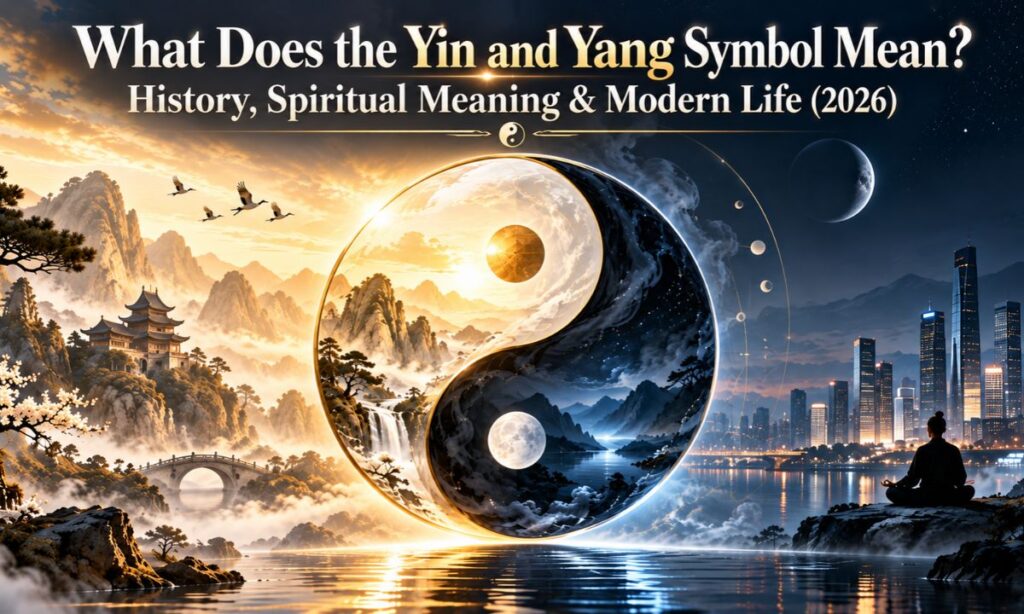

The yin and yang symbol is a circle divided into a black half and a white half, each holding a small dot of the opposite color. It stands for opposite forces that depend on each other and keep changing into one another. Its formal name is the taijitu.
You will find it on jewelry, tattoos, yoga studios, and even a national flag. This guide explains what it means, where it came from, what each color represents, and how people use it in love, friendship, and daily life.
What Does the Yin and Yang Symbol Mean? – Quick Meaning
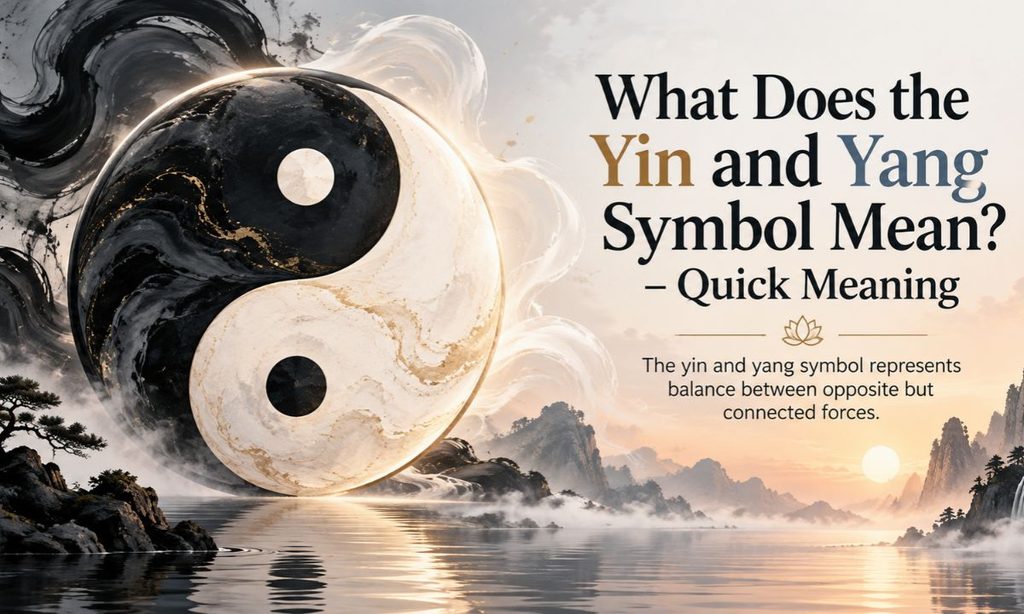
The yin and yang symbol represents balance between opposite but connected forces. Yin is the dark half, linked with rest, receptivity, and the feminine in traditional Chinese thought. Yang is the light half, linked with activity, brightness, and the masculine.
Three details carry the meaning. The circle stands for wholeness. The curved boundary shows that neither side is fixed. The two dots show that each side holds a seed of the other.
Origin & Background
The ideas of yin and yang are older than the picture. They appear in early Chinese texts such as the I Ching, where a solid line is yang and a broken line is yin, and they later shaped Taoism and traditional Chinese medicine.
The diagram came later. The Song dynasty philosopher Zhou Dunyi (1017 to 1073) described a Diagram of the Supreme Ultimate in his Taijitu shuo, a cornerstone of Neo-Confucian thought. The swirling design most people know today developed in later centuries, with the Ming scholar Lai Zhide credited for the interlocking spirals. The version with two dots became more common from the 1960s, when English speakers started calling it the yin-yang symbol. Scholars still debate the earliest source of the diagram, so claims of a single inventor or exact date deserve caution.
Yin yang meaning in love
In relationships, yin and yang describe partners who complement each other rather than mirror each other. One may be talkative and the other reflective, and the pairing works because each supplies what the other lacks.
The symbol also suggests that balance shifts. Healthy couples trade roles, such as giving and receiving or leading and listening. It is a metaphor, not a prediction, and it does not mean a good relationship needs opposite personalities.
Real-Life Conversations
People use the phrase to describe pairs, moods, and designs. Here is how it sounds in practice:
- “We’re such a yin and yang. I plan everything and she improvises.”
- “After a loud week, I need some yin time.”
- “Is that a yin yang tattoo? What’s the story behind it?”
- “Our team works because one of us pushes and the other slows us down.”
Also Read This:Evil Eye Symbol Meaning: History, Beliefs & Modern Uses Explained (2026)
Emotional & Psychological Meaning
Psychologically, the symbol works as a metaphor for holding opposites together: effort and rest, confidence and doubt, work and play. The dots remind people that strong feelings often contain their opposite, such as excitement mixed with nerves.
It is a philosophical symbol, not a clinical tool. Some modern writers compare yin and yang to the body’s stress and rest responses, but that is an analogy outside the original theory. For health questions, rely on a qualified professional.
Yin Yang meaning in friendship
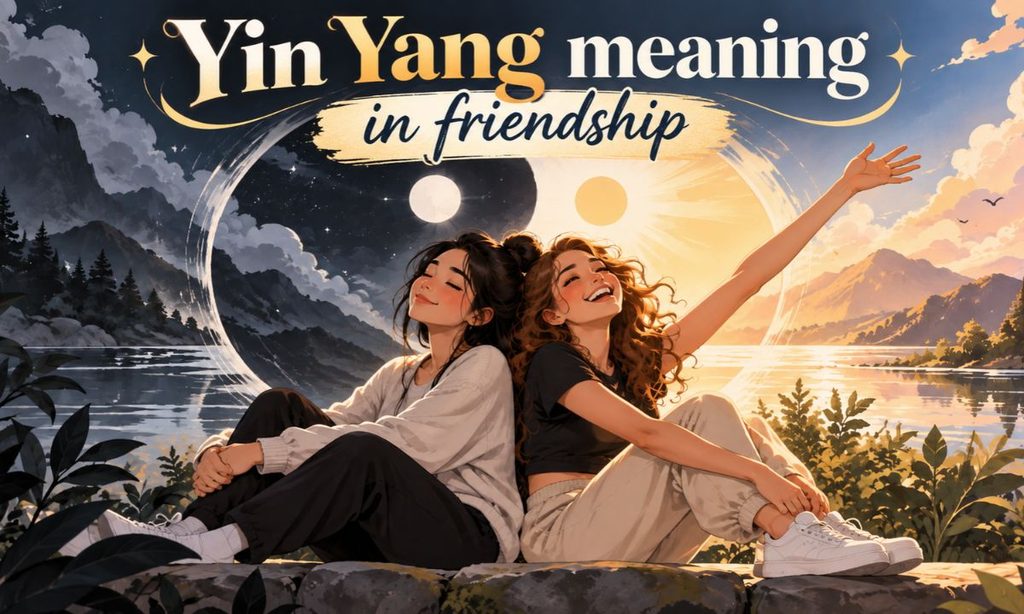
Between friends, “yin and yang” usually means two people with different temperaments who fit well together, such as a calm friend and an energetic one. It is a compliment about balance. It differs from the slang “twin,” which points to shared energy rather than complementary differences.
Usage in Different Contexts
- Taoism and philosophy: a picture of constant change and interdependence.
- Traditional Chinese medicine: a framework for describing balance in the body.
- Feng shui: balancing bright, active spaces with calm, restful ones.
- Tai chi: the name comes from taiji, the supreme ultimate that yin and yang arise from.
- Design and flags: the South Korean flag features the taegeuk, a close relative of the symbol.
When NOT to Use It
- As an excuse for behavior, such as “I’m just very yang, so I’m aggressive.” The idea is about balance, not permission.
- As a stand-in for good versus evil. Neither side is bad.
- As a stereotype about men and women. The pairing is symbolic.
- As a substitute for medical advice.
- As a joke in settings where it is treated as sacred.
Yin yang tattoo meaning
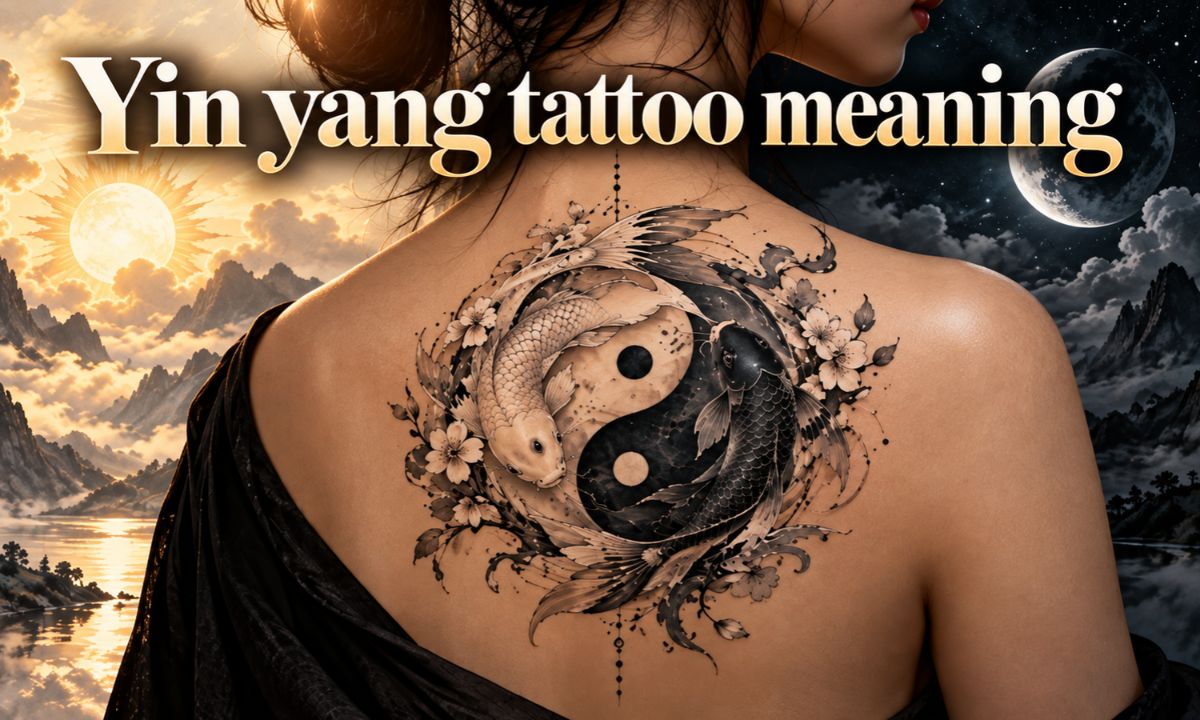
A yin yang tattoo usually signals a commitment to balance, acceptance of opposing sides of yourself, or a reminder that hard periods change. Popular variations include two koi fish forming the circle, a sun and moon pairing, and colored versions.
Before committing, confirm that the dots sit inside the opposite halves and that the artist understands the layout. If you add other elements, such as characters or animals, learn what they mean so the design says what you intend.
Common Misunderstandings
- Yin is not evil and yang is not good. Both are necessary.
- The halves are not frozen. As one grows, the other shrinks.
- It does not have to be black and white. Colors vary across designs.
- It is not only about gender. Day and night, summer and winter, and action and rest all fit.
- It has no single known creator. The concept is ancient and the diagram evolved over time.
Comparison Table
| Aspect | Yin | Yang |
|---|---|---|
| Color in the symbol | Black or dark | White or light |
| Quality | Receptive, restful | Active, outward |
| Associations | Earth, water, night, winter | Heaven, sun, day, summer |
| I Ching line | Broken | Solid |
| Traditionally linked with | Feminine | Masculine |
How to Respond When Someone Uses It
- If it is a compliment, accept it: “I need your calm to balance my chaos.”
- If you are unsure what they mean, ask: “Do you mean we’re opposites or that we fit together?”
- If it is used to excuse bad behavior, push back kindly and bring the conversation back to balance.
- If it is a tattoo or gift, ask about the story behind it.
Yin Yang which color is female

Black, the yin half, is the side traditionally associated with the feminine. White, yang, is traditionally linked with the masculine.
This is symbolic shorthand, not a statement about real people. Yin and yang describe qualities, and every person contains both. The color rule is also a convention: the Korean taegeuk uses red and blue, and many modern designs use other colors.
Regional & Cultural Usage
In China, the concept sits at the center of Taoism, Neo-Confucianism, feng shui, and traditional medicine. Korea adopted the taegeuk for its national flag in the 1880s. Western audiences met the symbol mainly through wellness culture, martial arts, and pop culture, and the English term yin-yang symbol spread from the 1960s.
Similar swirl patterns appear on prehistoric European artifacts, and modern scholars sometimes label them “yin yang symbols.” That is a visual resemblance, not evidence of the same meaning.
Is It Safe for Kids?

Yes. The symbol is family-friendly and has no inappropriate slang meaning. It is easy to explain to children as night and day, or breathing in and breathing out: two parts of one whole.
Frequently Asked Questions
Is yin evil and yang good?
No. Both are equal and necessary, and each one contains a bit of the other.
What do the dots in the yin yang symbol mean?
The dots show that each force holds a seed of its opposite. They also hint that one side can turn into the other.
Is the yin yang symbol religious?
It comes from Chinese philosophy and is closely tied to Taoism, but it is also used in Neo-Confucianism, medicine, and secular settings. You do not need to follow a religion to use it.
Who created the yin yang symbol?
No single creator is known. Zhou Dunyi described an early diagram in the Song dynasty, and the Ming scholar Lai Zhide is credited with the swirling form.
Can I get a yin yang tattoo if I’m not Chinese?
Many people around the world do. Learn its meaning first and wear it respectfully.
Conclusion
The yin and yang symbol teaches that opposites are partners. Dark and light, rest and action, and giving and receiving all depend on each other and keep shifting. Whether it appears in a relationship, a friendship, or a tattoo, its core message stays the same: wholeness comes from balance, not from picking one side.


Pingback: Gaara Symbol Meaning: What His Forehead Tattoo Really Means in Naruto (2026)
Pingback: What Does HB Mean in Text? Meaning, Slang Uses & Examples (2026)