

SMH means “shaking my head” (or “shake my head”). In a text, it signals disapproval, disbelief, or disappointment, the written version of a slow head shake at something you find silly, frustrating, or hard to believe.
It is one of the most established pieces of internet shorthand. Merriam-Webster and Dictionary.com both list it, and the earliest dated definition goes back to 2004. This guide covers where SMH came from, how tone and context change its feel, how it compares with SMDH and SMFH, and how to reply.
Two other expansions, “so much hate” and “scratching my head,” are real but uncommon. Several other claimed meanings have no dictionary support, and those are sorted out below.
SMH – Quick Meaning
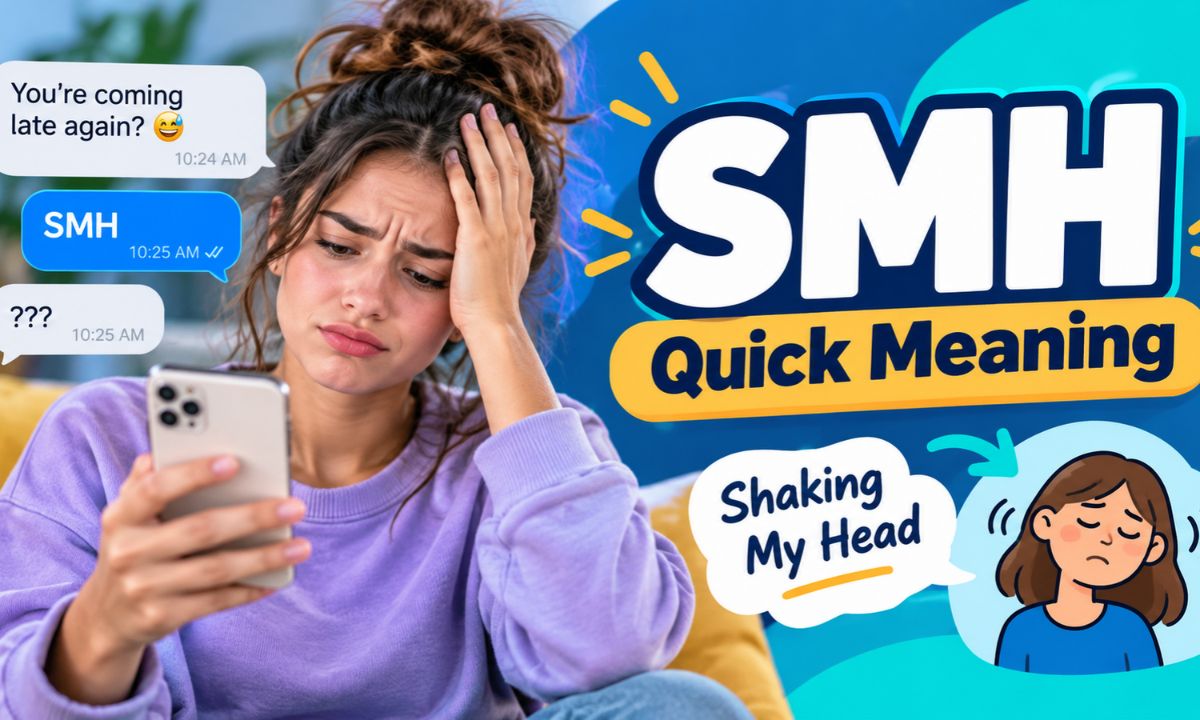
SMH is an informal initialism for “shaking my head.” Merriam-Webster defines it as a way to express disapproval, dismay, or disbelief, and Dictionary.com adds frustration and impatience.
- Full form: shaking my head, or shake my head
- Core meaning: disapproval, disbelief, disappointment, or exasperation
- Tone: mild to moderate, often weary, sarcastic, or teasing
- Where it sits: usually at the end of a message, or alone as a full reply
- Formality: informal, best kept out of professional writing
Origin & Background
The earliest dated record is an Urban Dictionary entry submitted on February 14, 2004, which defined SMH as a reaction to something so foolish that words fall short, according to Know Your Meme. That is the earliest documented definition, not proof of first use, and no source I found identifies who coined it.
The stronger form SMDH (“shaking my damn head”) was submitted to Urban Dictionary in 2007. The Online Slang Dictionary added SMH in January 2012, and Vice ran a 2013 piece questioning what the term even meant anymore, noting that some people read it as “so much hate.”
Oxford Dictionaries added SMH to its online dictionary in August 2014, alongside YOLO and FML. Some explainer pages say it entered the Oxford English Dictionary in 2015, but the 2014 addition was to the separate online Oxford Dictionaries site, so that claim is inaccurate.
SMH Mean in Text From a Guy
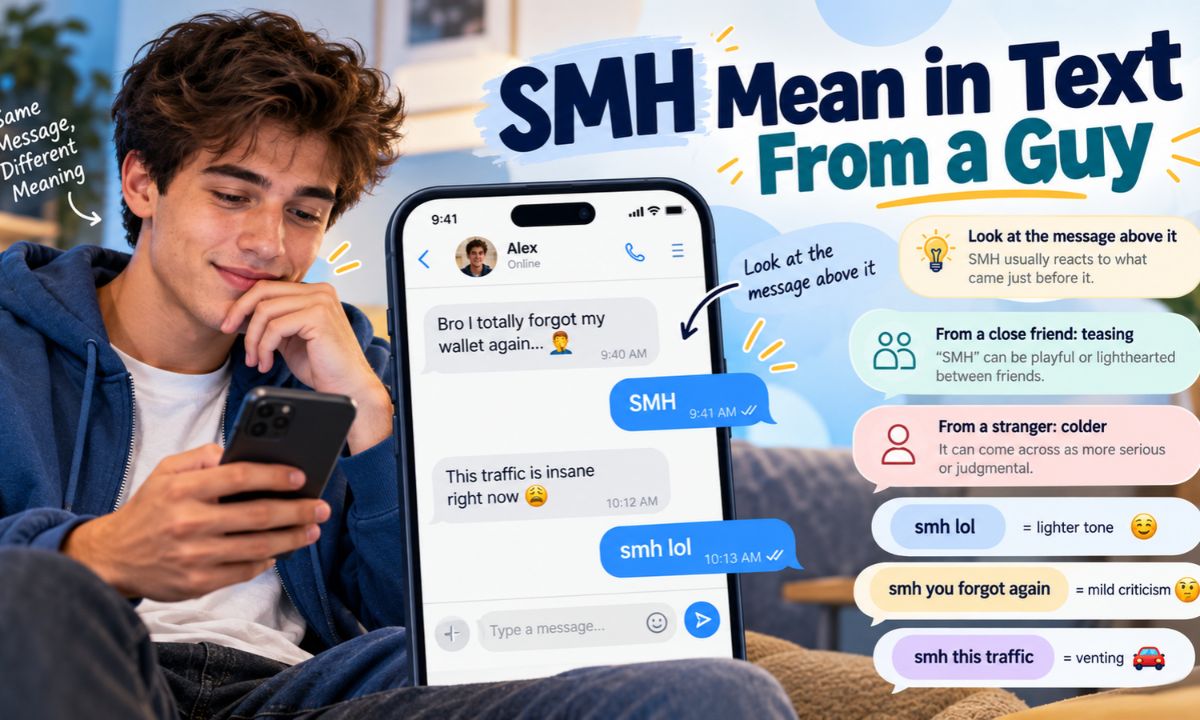
The sender’s gender does not change what SMH means. A guy, a girl, or anyone else who types it is expressing the same shaken-head reaction. Pages claiming that men use SMH sarcastically while women use it differently offer no evidence for the split.
What does change the reading is everything around the letters:
- What came just before: SMH reacts to a specific thing, so look at the message above it
- The relationship: from a close friend it is usually teasing, from a stranger it can feel colder
- Punctuation and extras: “smh lol” is lighter than a bare “smh.”
- Whether it points at you: “smh you forgot again” is mild criticism, while “smh this traffic” is just venting
Example: a guy texting “smh he left me on read again” is venting about a situation. A girl texting the same line means exactly the same thing.
Also Read This:What Does CYC Mean in Text? CYC Meaning, Slang Uses & Examples (2026)
Real-Life Conversations (How People Actually Use SMH)
These examples are illustrative, written to show the common patterns.
- Disappointment: “Third reschedule this month, smh.”
- Disbelief: “He paid nine dollars for bottled water smh”
- Teasing: “you put your keys in the fridge again smh lol”
- Standalone reaction: someone sends a screenshot of bad news and you reply with just “smh”
- Verb-like use: “I’m just smh at this whole situation”
- Social posts: a hashtag such as #smh, or a reaction GIF of someone shaking their head
Emotional & Psychological Meaning
SMH is an idiom. The sender is almost never shaking their head as they type, and the letters stand in for the feeling that gesture carries. It lets someone register a reaction without writing out an argument.
Dictionary.com describes its tone as often implying impatience with perceived needless foolishness, and that fits how it tends to land. It sits below anger and above a shrug. In my reading, it often carries resignation: the sender expected better and is not surprised to be let down. That is an interpretation of usage, not a measured finding.
Usage in Different Contexts
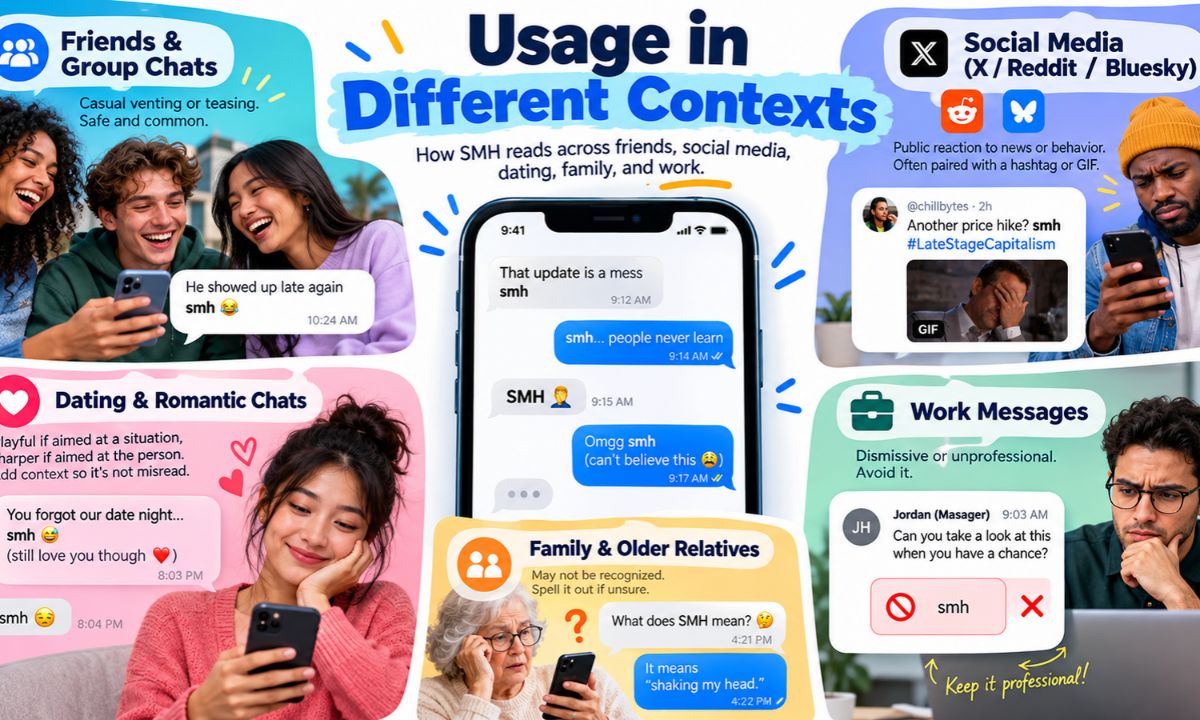
| Context | How SMH Usually Reads | Advice |
|---|---|---|
| Friends and group chats | Casual venting or teasing | Safe and common |
| Social media (X, Reddit, Bluesky) | Public reaction to news or behavior | Often paired with a hashtag or GIF |
| Dating or romantic chats | Playful if aimed at a situation, sharper if aimed at the person | Add context so it is not misread |
| Family and older relatives | May not be recognized | Spell it out if unsure |
| Work messages | Dismissive or unprofessional | Avoid it |
Common Misunderstandings
- “It is always an insult.” Most of the time it targets a situation, not a person.
- “It means stupid mindless humans” or “so much hype.” These appear on some explainer pages with no dictionary backing. “So much hate” and “scratching my head” are the alternates Dictionary.com recognizes, and both are rare.
- “It is in the OED since 2015.” The documented addition was to Oxford Dictionaries online in 2014.
- “A guy and a girl mean different things by it.” They do not.
- “The sender is literally shaking their head.” It is a figure of speech.
Comparison Table
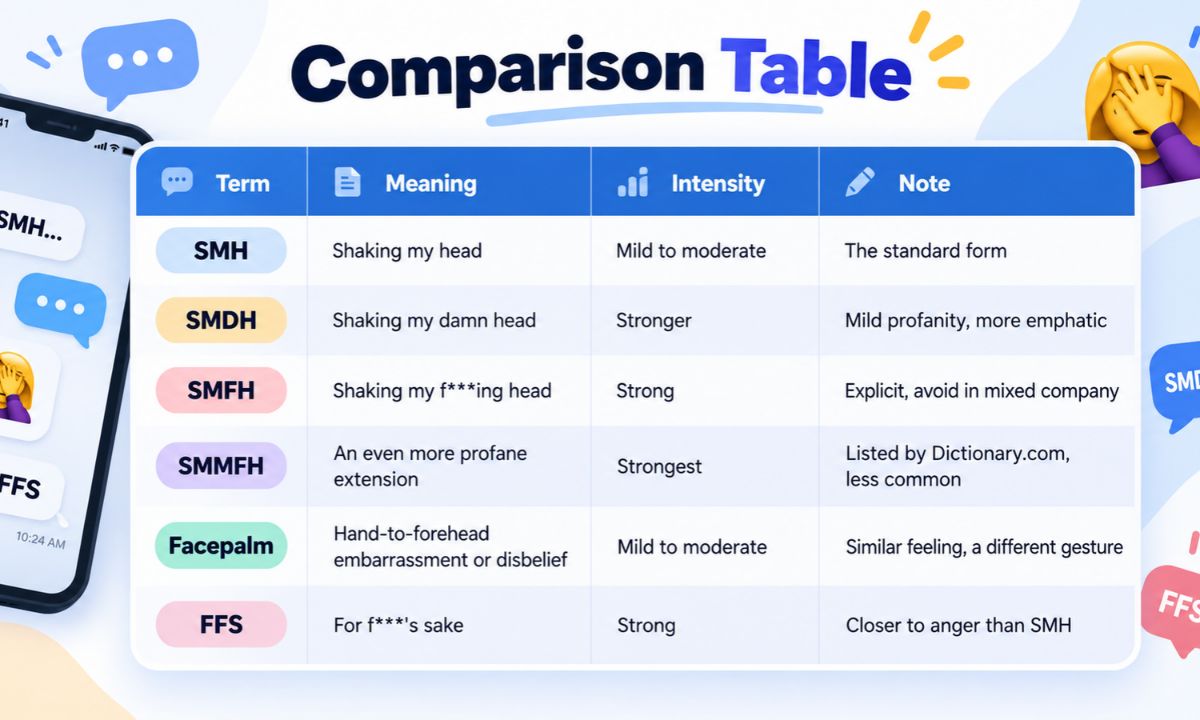
| Term | Meaning | Intensity | Note |
|---|---|---|---|
| SMH | Shaking my head | Mild to moderate | The standard form |
| SMDH | Shaking my damn head | Stronger | Mild profanity, more emphatic |
| SMFH | Shaking my f***ing head | Strong | Explicit, avoid in mixed company |
| SMMFH | An even more profane extension | Strongest | Listed by Dictionary.com, less common |
| Facepalm | Hand-to-forehead embarrassment or disbelief | Mild to moderate | Similar feeling, a different gesture |
| FFS | For f***’s sake | Strong | Closer to anger than SMH |
Variations / Types of SMH
- SMDH, SMFH, SMMFH: intensified versions that add a swear word for emphasis.
- #smh and #smdh: hashtag forms used to tag exasperation on social platforms.
- Reaction GIFs: head-shake clips captioned “smh” and sent through GIF keyboards.
- So much hate: a less common reading, used to comment on disdain, and only clear from context.
- Scratching my head: an uncommon reading that signals puzzlement instead of disapproval.
How to Respond When Someone Uses SMH

Reply to the thing they are reacting to, not to the three letters.
- Agree and commiserate: “Right? I can’t believe it either.”
- Ask for the story: “Wait, what happened?” works when there is no context.
- Tease back: if the tone is playful, match it with “okay, okay, I know.”
- Check if it is aimed at you: “Did I say something off?” is a calm way to find out.
- Let it go: a bare “smh” about a trivial thing sometimes needs no reply at all.
Regional & Cultural Usage
No source I found documents a regional version of SMH. Merriam-Webster’s examples come from X, Reddit, and Bluesky, which shows how widely it travels across English-language platforms. Dictionary.com notes that it is used heavily across digital communication, especially in Black internet communities.
No source traces SMH to one community, city, or person, so its exact origin should be treated as unsettled. People less familiar with internet shorthand may not recognize it, so write out “shaking my head” in mixed-age or professional settings.
Frequently Asked Questions
What does SMH stand for in text?
SMH stands for “shaking my head.” It expresses disapproval, disbelief, or disappointment.
Is SMH rude?
Not by default, since it usually reacts to a situation and not a person. It can feel dismissive when aimed at someone, especially with no explanation.
What is the difference between SMH and SMDH?
SMDH means “shaking my damn head” and carries more frustration than SMH. SMFH adds stronger profanity and is more explicit still.
Can SMH mean something other than shaking my head?
Occasionally, it can mean “so much hate” or “scratching my head,” but both are rare and depend on context. Other expansions seen online are unsupported by dictionaries.
Is it okay to use SMH at work?
It is best avoided in professional messages because it can read as dismissive. Write out what you mean instead.
Conclusion
SMH is a long-established way to express disapproval, disbelief, or weary disappointment, and “shaking my head” is the meaning to assume unless context clearly says otherwise. Sender gender does not change it, but tone, relationship, and what came before do.
When you see it, answer the situation behind it. When you use it, keep it among people who share your shorthand, and reach for plain words in professional or mixed-age settings.



Pingback: What Does 🤍 Mean in Text? White Heart Meaning & Uses (2026)