
Quick Answer Box
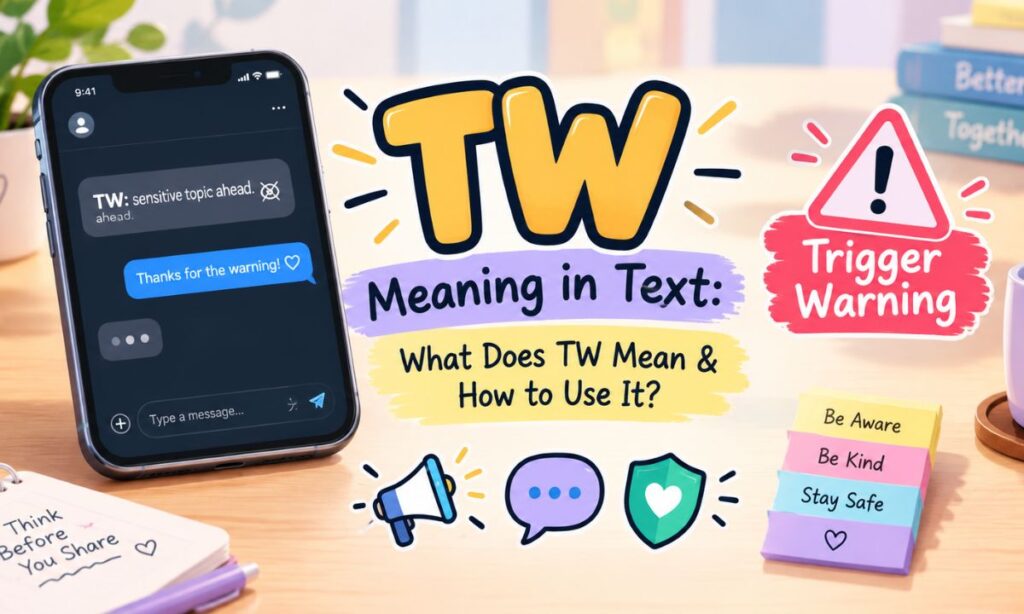
TW stands for “trigger warning.” It’s a short heads-up placed before a message, post, or caption to flag that what follows touches on a sensitive or potentially distressing topic, things like violence, abuse, self-harm, or grief, so the reader can decide whether they’re ready to engage with it right now. It almost always appears in the format “TW: [topic],” such as “TW: mentions of anxiety.”
What Does TW Mean In Text?
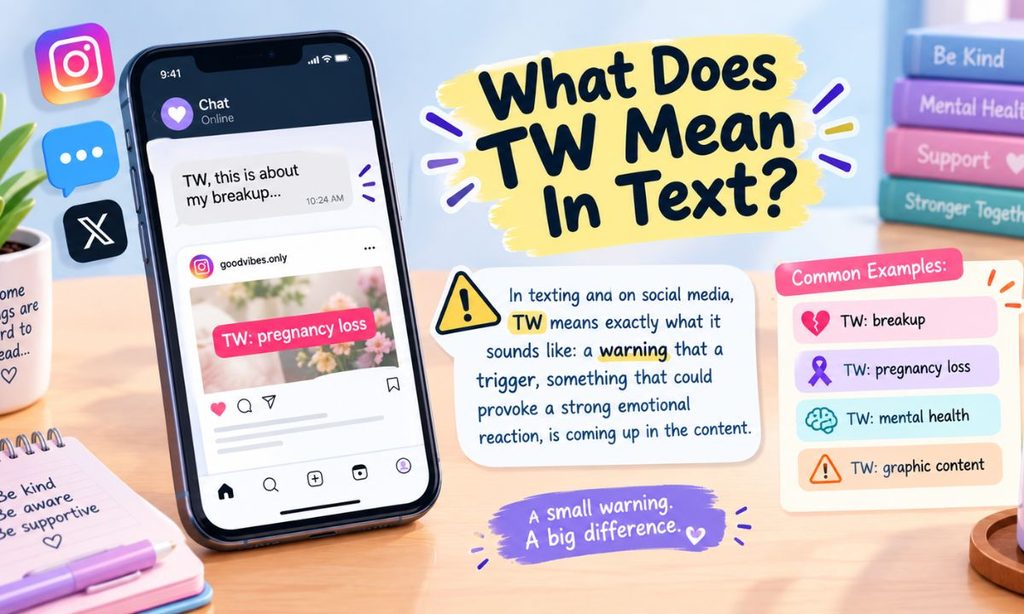
In texting and on social media, TW means exactly what it sounds like: a warning that a trigger, something that could provoke a strong emotional reaction, is coming up in the content. Someone might text a friend “TW, this is about my breakup” before venting, or open an Instagram caption with “TW: pregnancy loss” before sharing a personal story.
The label itself doesn’t describe the content in detail. It just flags that sensitive material is ahead, and the specific topic usually follows right after the colon. That structure lets the reader make an informed choice in a couple of seconds instead of stumbling into something upsetting without warning.
Origin And Evolution Of TW
The idea behind TW didn’t start online. It comes from trauma psychology, where clinicians use the word “trigger” to describe a stimulus, a word, image, or situation, that can provoke a strong physical or emotional trauma response in someone with PTSD or a related condition.
Written trigger warnings moved online in the early 2000s, largely through feminist blogs and support forums discussing abuse and sexual violence. The practice spread through LiveJournal and later Tumblr communities in the mid-2000s and 2010s, where full phrases got shortened to the two-letter “TW” the same way most texting slang gets compressed for speed. From there it carried over to Twitter, Reddit, TikTok, and Instagram, where it shows up daily now.
Psychological And Emotional Meaning Of TW
For people who’ve experienced trauma, encountering related content unexpectedly can trigger a real physiological response, things like a racing heart, flashbacks, or a panic reaction, not just discomfort. A TW label gives that person a moment to brace themselves or step away before the content actually appears.
That’s the emotional logic behind the abbreviation: it hands a small amount of control back to the reader. Instead of being surprised, they get to choose the timing, or choose not to engage at all.
TW meaning Gen Z
Among Gen Z, TW has drifted beyond its clinical roots into a much broader everyday habit. It still gets used for serious topics, but it also shows up ahead of things that are only mildly uncomfortable, like spiders, needles, or a messy breakup story, rather than exclusively trauma-linked material.
That shift reflects a generation that’s generally more comfortable naming emotions and mental health topics out loud. Some of that usage is genuinely protective, and some of it is closer to a stylistic habit picked up from the format itself.
Communication Function Of TW
Functionally, TW works like a subject line for sensitive content. It previews what’s coming without describing it in full, which lets the reader decide how and when to engage. Sending one signals a specific kind of social awareness: “I want you to have a choice here, not just be caught off guard.”
That’s different from simply avoiding a hard topic altogether. TW lets the conversation happen while still respecting the other person’s headspace.
Cultural And Generational Context Of TW
TW’s popularity tracks with a broader cultural shift toward discussing mental health openly rather than treating it as private or shameful. Language that used to live mostly in therapy offices, terms like “trigger,” “boundaries,” and “trauma response,” has moved into everyday texting and social captions over the past decade.
How strictly a community expects TW use to appear varies. Mental health and recovery spaces tend to treat it as close to mandatory before certain topics, while general social feeds treat it more loosely.
Why TW Became Popular
Several things pushed TW into mainstream use at once: the rise of personal storytelling on Instagram and TikTok, growing mental health advocacy accounts normalizing the vocabulary, and platform community guidelines that encourage or require content warnings on sensitive posts. As more creators openly discussed difficult topics, a fast, recognizable way to flag them became necessary.
TW meaning in text funny
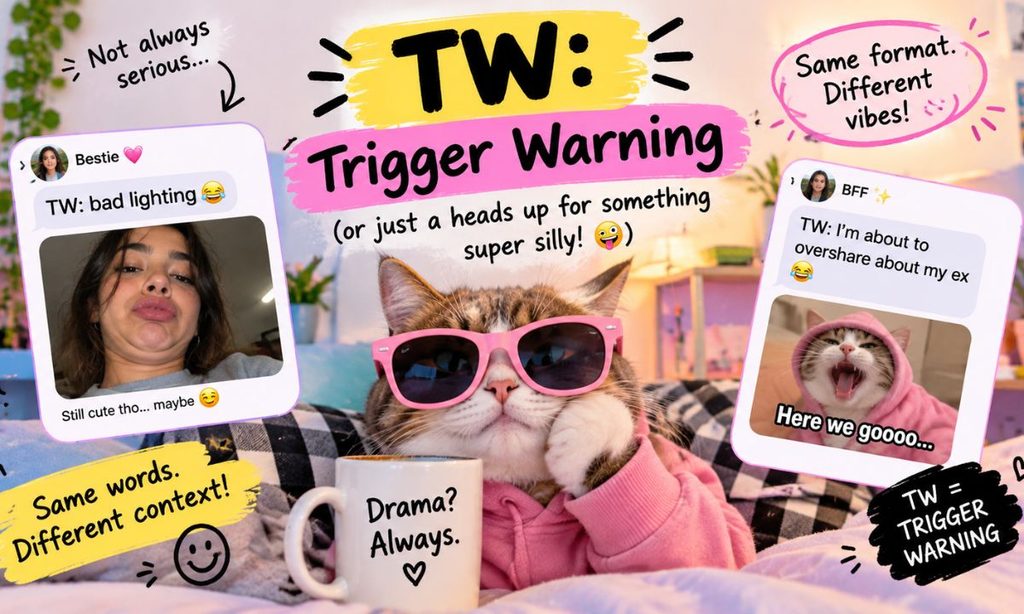
Not every TW is serious. People also use it ironically, tacking it onto low-stakes or embarrassing content for comedic effect: “TW: bad lighting” before an unflattering selfie, or “TW: I’m about to overshare about my ex” before a dramatic text. This version borrows the format of a real warning to add a joking, self-aware tone rather than to flag anything genuinely distressing.
Semantic Core Meaning Of TW
Strip away the context, and TW does two things at once. First, it gives advance notice that sensitive content is coming. Second, it hands the reader a choice, whether to keep reading right now, come back later, or skip it entirely. Every version of TW, serious or joking, casual or clinical, is built on that same two-part structure.
Most Common TW Meaning In Text (Deep Dive)
“Trigger warning” is overwhelmingly the dominant meaning across texting and social media, and it clusters around a fairly consistent set of topics. The most common categories people flag with TW include:
- Violence or graphic injury
- Self-harm or suicide
- Eating disorders or disordered eating
- Abuse, including domestic or sexual abuse
- Death, grief, or pregnancy loss
- Substance use or addiction
These categories show up so often that most readers recognize the format instantly, even without reading the specific topic that follows.
Meaning Based On Context
TW usually means “trigger warning,” but the setting changes how strictly that holds.
| Context | Likely Meaning | Notes |
|---|---|---|
| Texting between friends | Trigger warning | Casual, may cover minor topics too |
| Social media captions or posts | Trigger warning | Near-universal meaning |
| Mental health or support communities | Trigger warning | Often treated as expected practice |
| Work emails or project chats | This week or teamwork | Rare slang meaning, context-dependent |
| Older Twitter-era posts | Twitter (self-reference) | Largely outdated usage |
How TW Is Used In Real Conversations
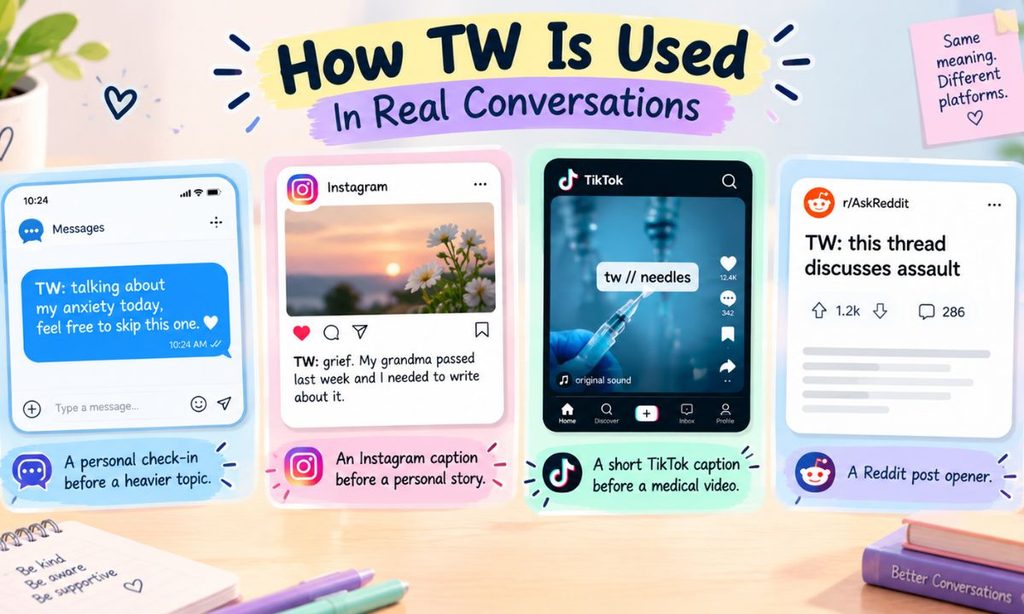
- “TW: talking about my anxiety today, feel free to skip this one” – a personal check-in before a heavier topic
- “TW: grief. My grandma passed last week and I needed to write about it.” – an Instagram caption before a personal story
- “tw // needles” – a short TikTok caption before a medical video
- “TW: this thread discusses assault” – a Reddit post opener
TW Meaning On Different Platforms
| Platform | Typical Usage |
|---|---|
| Twitter/X | Placed before threads discussing trauma, illness, or graphic news |
| TikTok | Spoken or captioned before sensitive videos, often shortened to “tw//” |
| Used in captions and story text before personal or heavy posts | |
| Common in support subreddits, often required by community rules | |
| Discord | Used in server channels before sharing personal struggles |
| Occasional use in group chats before forwarding heavy news |
When To Use Vs When To Avoid TW
- Use it when sharing content involving violence, self-harm, abuse, grief, or other topics known to be distressing for some readers
- Use it in mental health or support spaces, where it’s often expected practice
- Use it when messaging someone you know has a specific sensitivity
- Avoid it when the topic is genuinely mundane, since the label can create a false alarm
- Avoid it in professional settings, where the acronym is more likely to be misread as “this week”
- Avoid overusing it on nearly every post, since that dilutes its usefulness for people who actually rely on it
Also Read This:What Does FSS Mean in Text? Meaning, Uses & Examples
Hidden Or Risky Meanings Of TW
Outside of sensitive-content contexts, TW occasionally stands for something else. Common alternates include:
- This Week – used in work emails or planning chats
- Teamwork – occasional workplace shorthand
- Twitter – an older, mostly outdated way of referencing the platform itself
- Twin – rare, used affectionately between close friends
The real risk isn’t misreading these rarer meanings, it’s overuse. When TW gets attached to nearly everything, including jokes and minor inconveniences, it can lose some of its function for people who rely on it to genuinely prepare for difficult content.
Variations And Forms Of TW
TW shows up in a few different written forms depending on the platform and the poster’s habits: “TW:”, “tw //”, and “TW -” all function the same way. Its closest sibling is CW, short for “content warning,” which covers a broader range of material, including things that aren’t necessarily trauma-linked, like spoilers or flashing lights. Some communities use TW and CW interchangeably. Others reserve TW specifically for trauma-related topics and use CW for everything else.
TW Vs Similar Slang
| Term | Meaning | Typical Use |
|---|---|---|
| TW | Trigger warning | Trauma-related or distressing topics specifically |
| CW | Content warning | Broader category, including non-trauma sensitive content |
| NSFW | Not safe for work | Sexual, graphic, or explicit content |
| Spoiler Alert | Warns of plot reveals | Entertainment and media discussions only |
How To Decode The Correct Meaning
When TW shows up somewhere ambiguous, a quick process usually clears it up:
- Check the platform. Social media and support communities almost always mean “trigger warning.”
- Read what follows the colon. A topic like grief, violence, or anxiety confirms the standard meaning.
- Consider the setting. A work chat or planning thread points toward “this week” instead.
- When it’s still unclear, just ask. A quick “what do you mean by TW here?” clears up any confusion in one message.
How To Respond To TW
- Acknowledge it briefly before continuing, like “thanks for the heads-up” or a simple emoji
- Decide whether you want to read on now, later, or skip it, without needing to explain your choice
- If you skip it, you don’t owe an explanation, a TW exists precisely so people can opt out quietly
- If the topic affects you personally, it’s fine to say so and step away from the conversation
Common Misunderstandings About TW
- Believing TW is a form of censorship. It’s not; nobody is required to use one, and the content still gets posted, just with a preview attached.
- Assuming one warning covers everyone’s needs. Triggers vary a lot person to person, so a TW is a general courtesy, not a guarantee.
- Thinking TW always signals something extremely graphic. Plenty of TWs cover moderate topics like anxiety or a hard day, not only severe trauma.
- Assuming casual or joking use has “ruined” the term. Whether frequent casual use weakens TW’s usefulness for people who genuinely need it is a debated point, with reasonable views on both sides.
Regional And Cultural Usage Of TW
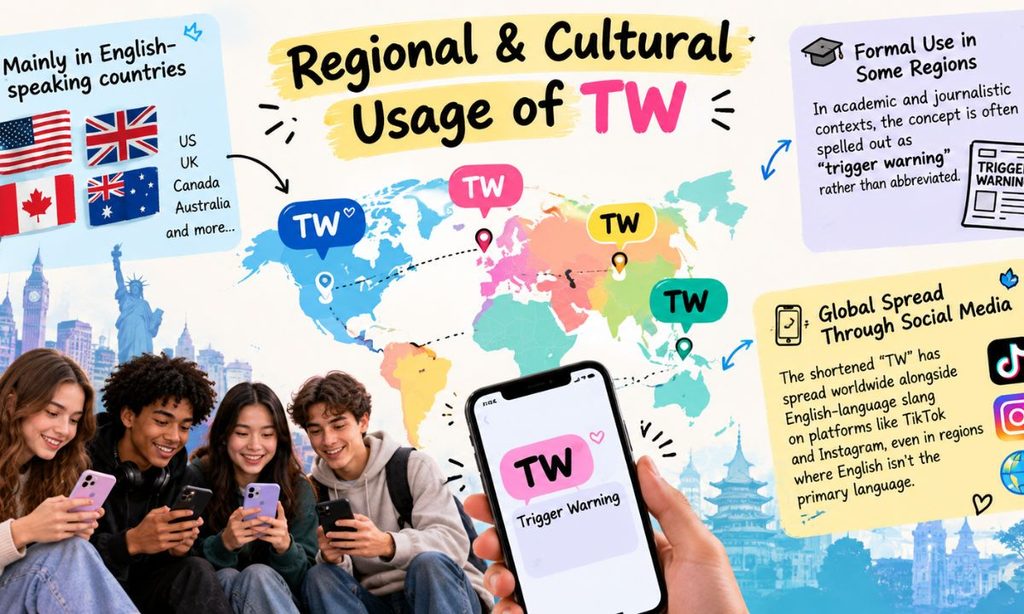
TW is primarily an English-language internet term, and its heaviest usage is concentrated in the US, UK, and other English-speaking online spaces. Academic and journalistic contexts in some regions use a more formal version of the same concept, often spelled out as “trigger warning” rather than abbreviated. In everyday texting culture, the shortened “TW” has spread globally alongside English-language slang on platforms like TikTok and Instagram, even in regions where English isn’t the primary language.
Frequently Asked Questions
Does TW always mean “trigger warning”?
In casual texting and on social media, yes, almost always. Outside those contexts, like in work chats, it can occasionally mean “this week” or “teamwork” instead.
Is TW the same as CW?
They’re closely related, but TW usually refers specifically to trauma-related content, while CW, or “content warning,” covers a wider range of sensitive material, including things like spoilers.
Do I have to say what the trigger warning is about?
Not always, but naming the general topic, like “TW: grief,” makes the warning far more useful than just typing “TW” alone.
Is it okay to use TW jokingly?
Yes, plenty of people use it for lighthearted or embarrassing content, though it’s worth keeping that usage separate from genuinely sensitive topics so the label doesn’t lose meaning.
What should I do if I see a TW I want to skip?
Just scroll past or close the message. A trigger warning exists specifically so you can opt out without needing to explain yourself.
Conclusion
TW is one of the more thoughtful pieces of internet shorthand, since its entire purpose is giving someone a moment of choice before they encounter something difficult. Whether it shows up in a serious Instagram caption about grief or a joking text about a bad hair day, the underlying function stays the same: a quick heads-up, followed by the reader deciding what happens next.
Reading TW correctly comes down to context. The platform, the words that follow it, and the setting all point you toward the right meaning in a few seconds.



Pingback: DWU Meaning in Text: What Does DWU Mean & How to Use It?