
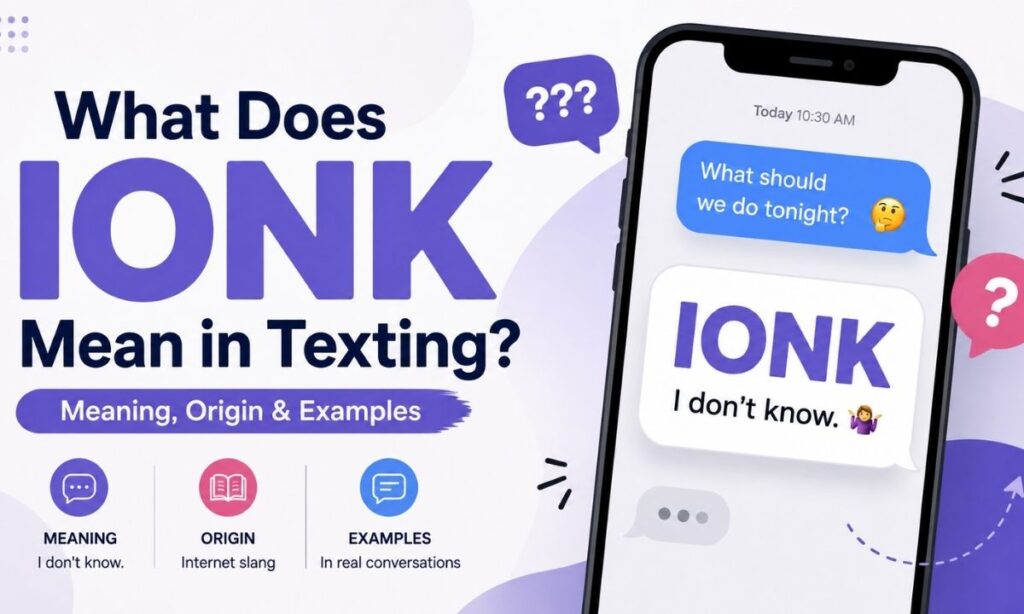

IONK is texting slang for “I don’t know.” It’s a phonetic spelling that mimics how people actually say the phrase out loud when they’re talking fast, closer to “ion-know” than a letter-by-letter abbreviation like IDK. You’ll mostly see it in texts, TikTok comments, and Snapchat replies from Gen Z and younger millennial users.
If someone just sent you “ionk” and you’re trying to figure out whether they’re genuinely clueless, brushing you off, or just typing fast, this guide covers exactly what the term means, where it came from, and how to read the tone behind it.
The Definition of IONK
IONK stands for “I don’t know,” written the way the phrase sounds when it’s said quickly and casually. It comes from combining “ion,” a common texting contraction of “I don’t,” with “k” for “know.” That makes IONK part of a small family of ion-based slang, alongside terms like “ionc” (I don’t care) and “iont” (I don’t want).
A small number of slang sites also list “I Only Now Know” as a secondary meaning, used to describe a sudden realization. This reading shows up far less consistently across usage examples and real conversations than the “I don’t know” meaning, so it’s worth knowing it exists, but treating “I don’t know” as the safe, default interpretation almost any time you see IONK on its own.
Origins and History of IONK
IONK doesn’t trace back to one specific person, app, or year. It grew out of the same texting culture that produced abbreviations like IDK, BRB, and LOL, where users shortened common phrases to save keystrokes and speed up conversation.
What sets IONK apart is that it isn’t built from initials at all. It’s built from sound. “I don’t know” gets slurred into something like “I-on-know” in casual speech, and texters eventually started spelling it the way it’s spoken rather than the way it’s technically written. This phonetic style picked up momentum as short-form video platforms took off in the early 2020s, since comment sections and captions reward slang that reads as fast and natural as talking.
How IONK Is Used in Texting
In practice, IONK works exactly like “I don’t know” or “IDK.” It shows up as a standalone reply, a quick admission of uncertainty, or a way to keep a conversation moving without committing to an answer. The main thing that changes is tone, not meaning.
- Answering a question you genuinely don’t have an answer to
- Deflecting a decision, like picking where to eat or what to do
- Reacting to something confusing or unexpected
- Signaling mild indifference without sounding harsh
Ionk Mean in Text From a Guy
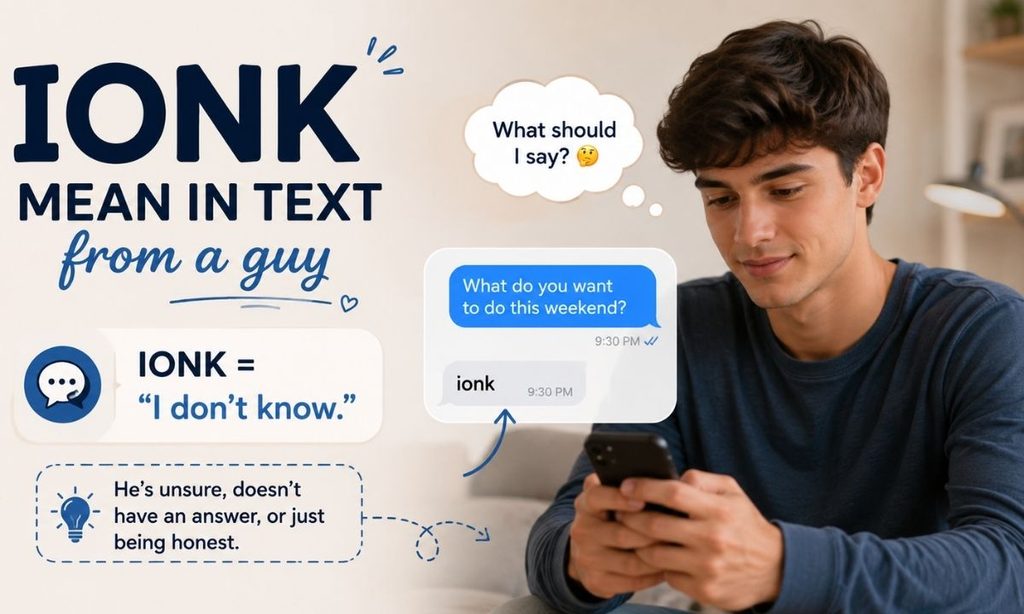
When a guy texts “ionk,” the meaning itself doesn’t change based on gender, but the tone often depends on what’s being asked. In response to a logistics question (“wyd tonight?”), it’s usually a plain, low-stakes “I have no idea yet.” In response to something more personal, like being asked how he feels about someone or something, a bare “ionk” with no follow-up can read as noncommittal or like he’s avoiding a direct answer.
The clearest signal is whether he adds anything after it. “Ionk, we’ll see” or “ionk, tbh” still feels open and conversational. A flat “ionk” and nothing else, especially after a longer pause, tends to read as closed off or disengaged.
Examples of IONK in Conversations
- “What time does the movie start?” — “Ionk yet, checking now”
- “Are we still doing dinner Friday?” — “Ionk, my schedule’s a mess this week”
- “Why did she seem upset earlier?” — “Ionk honestly, she didn’t say”
- “Do you like this song or is it mid?” — “Ionk, it’s growing on me lol”
IONK vs Similar Slang Terms
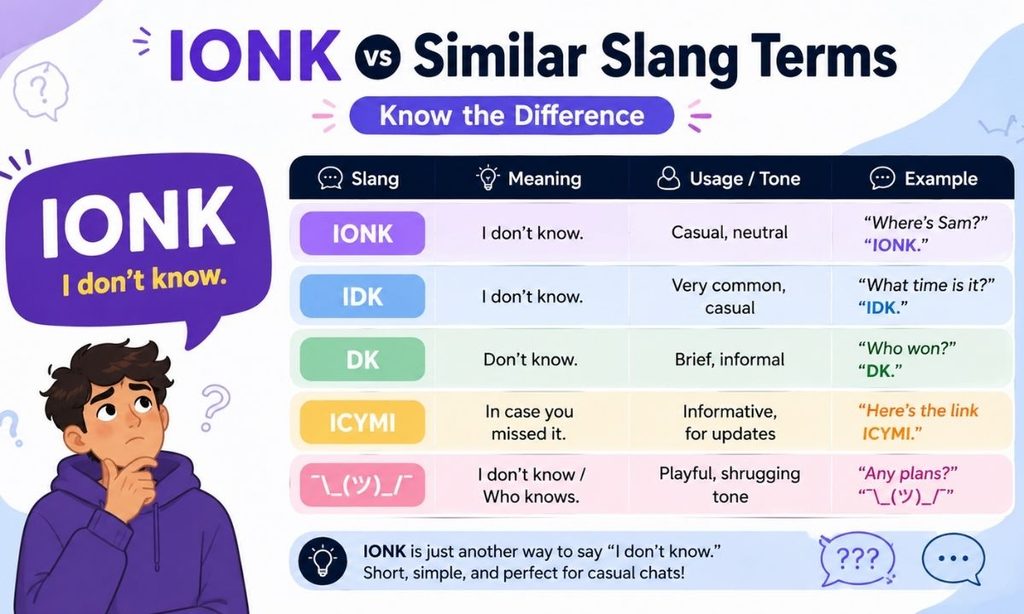
IONK sits inside a small cluster of “ion” based contractions, and it’s easy to confuse them since the endings look similar but change the meaning completely.
| Term | Full Meaning | Notes |
| IONK | I don’t know | Phonetic spelling, casual and youth-driven |
| IDK | I don’t know | Classic acronym, recognized by nearly all age groups |
| ION | I don’t | Root contraction, needs a word after it to make sense |
| IONC | I don’t care | Same family as IONK, different ending changes the meaning |
| IONT | I don’t want | Also built from “ion,” used before a noun or verb |
IONK and IDK mean the same thing, so the choice between them is really about tone rather than definition. IDK reads as neutral and works fine with almost anyone. IONK feels more playful, more casual, and more likely to show up in a text to a friend than in a message to a coworker.
IONK on Different Platforms
| Platform | Typical Usage |
| TikTok | Comments and captions reacting to confusing or relatable content |
| Snapchat | Quick, informal replies to plans or questions |
| DMs and comment replies, often paired with an emoji | |
| Text messages | Everyday back-and-forth between friends |
| Discord | Casual server chat, often reacting to game questions |
Ionk Meaning in Text From Girl
The meaning doesn’t shift based on who’s sending it, but the interpretation people search for tends to focus on the same thing either way: is this a genuine “I don’t know,” or a soft way of avoiding the question? When a girl sends “ionk” in response to a plan or a factual question, it’s almost always literal.
Where it gets more layered is in response to a personal or relationship-adjacent question. A quick “ionk lol” usually reads as playful uncertainty, not a real dodge. A one-word “ionk” with no punctuation and a longer gap before it can suggest she’s genuinely unsure, or isn’t ready to give a straight answer yet. Reading the rest of the conversation, not just the word itself, is what actually tells you which one it is.
Why IONK Became So Popular
A few things pushed IONK into wider use. Phonetic slang in general took off as texting became closer to spoken conversation, with terms like “gonna” and “kinda” already normalizing spelling things the way they sound. IDK had also been around long enough that it started to feel flat and overused, and IONK offered a fresher, more personality-driven alternative that says the same thing with a bit more character.
Short-form video also played a direct role. Comment sections on TikTok and Instagram reward slang that feels quick and conversational, and IONK fit that space naturally. Once it started showing up regularly in captions and replies, it spread the way most modern slang does, through repetition across group chats and comment threads rather than through any single viral moment.
Common Misunderstandings About IONK
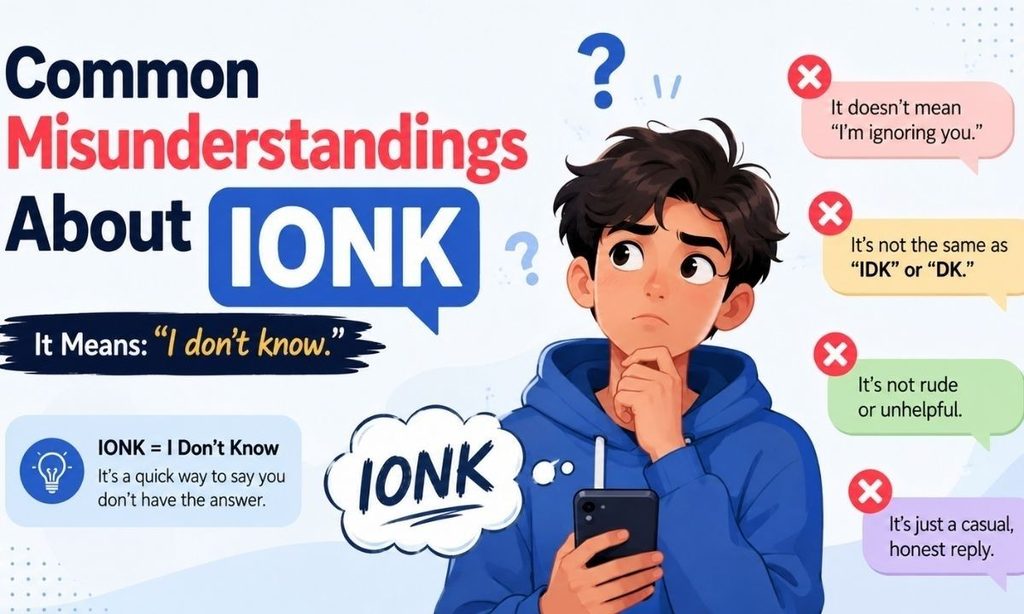
- Assuming it’s a typo for “I on know” or a name, rather than intentional slang
- Mixing it up with “ion” or “ionc,” which mean something different despite the similar spelling
- Reading a bare “ionk” as rude, when it’s usually just casual, not dismissive
- Expecting it to work the same way in a professional or formal message, where it reads as unprofessional
- Treating “I Only Now Know” as an equally common meaning, when “I don’t know” is by far the standard reading
Conclusion
IONK is a fast, phonetic way of texting “I don’t know,” built from the same “ion” family that gives us ionc and iont. The word itself rarely changes meaning based on who sends it or which platform it shows up on. What actually shifts is tone, and that comes from context, punctuation, and what’s said around it, not the three letters themselves. Once you can spot the difference between a genuine “no idea” and a soft dodge, IONK stops being confusing and just becomes another normal part of reading a text.
Frequently Asked Questions
Does IONK mean the same thing as IDK?
Yes, both mean “I don’t know.” IONK is simply a more casual, phonetic spelling favored by younger texters.
Is IONK rude to send?
Not inherently, but a bare “ionk” with no follow-up can feel dismissive in a serious or emotional conversation.
What’s the difference between ion, ionc, and ionk?
They’re all built from “ion” (I don’t), but the ending changes the meaning: ionc means “I don’t care,” ionk means “I don’t know.”
Is it okay to use IONK in a work chat?
No, it’s informal slang best kept to texts and casual social platforms rather than professional messages.
Does IONK mean something different from a guy or a girl?
No, the definition stays the same regardless of who sends it; tone depends on the conversation, not gender.

Pingback: What Does DTTM Mean in Texting? Meaning, Uses & Examples
Pingback: WYFF Meaning: What This Trending Text Slang Really Means