

Quick Answer Box
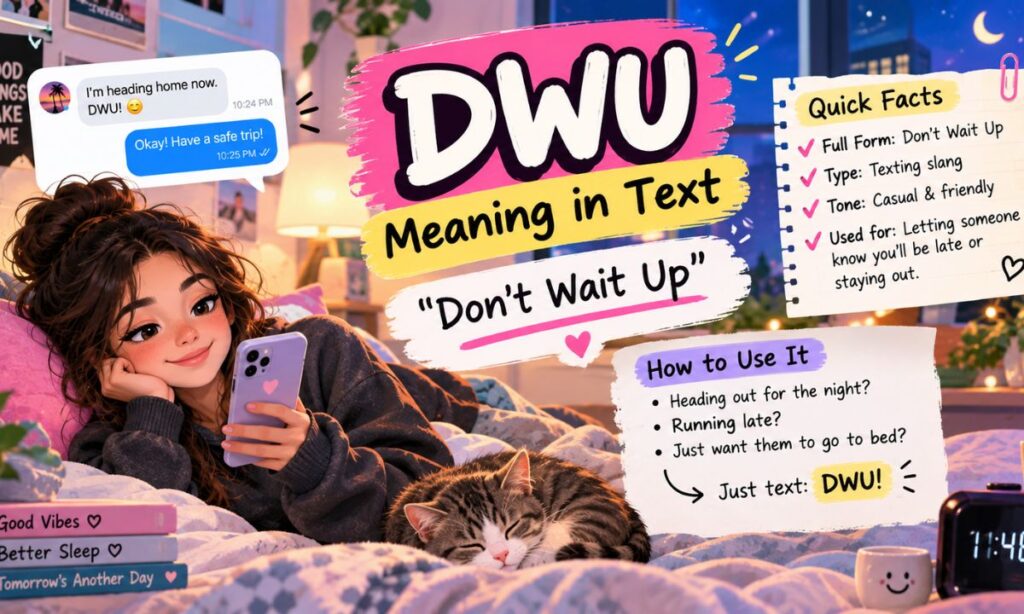
DWU stands for “Don’t Wait Up.” People send it to let someone know they’ll be out late, unavailable for a while, or heading somewhere without a clear return time, so the other person doesn’t stay awake or keep checking their phone waiting for a reply. It’s most common between partners, friends, and family members.
What Does DWU Mean In Text?
DWU is a quick way of saying “don’t stay up on my account.” It usually gets tacked onto the end of a message: “Out with the team tonight, DWU” or “Running behind, DWU.” The core idea is releasing the other person from any obligation to stay alert or keep checking in.
It’s less a question and more a heads-up. DWU doesn’t ask for anything back, it just closes the loop before the other person has to wonder where things stand.
Dwu meaning in text from a guy
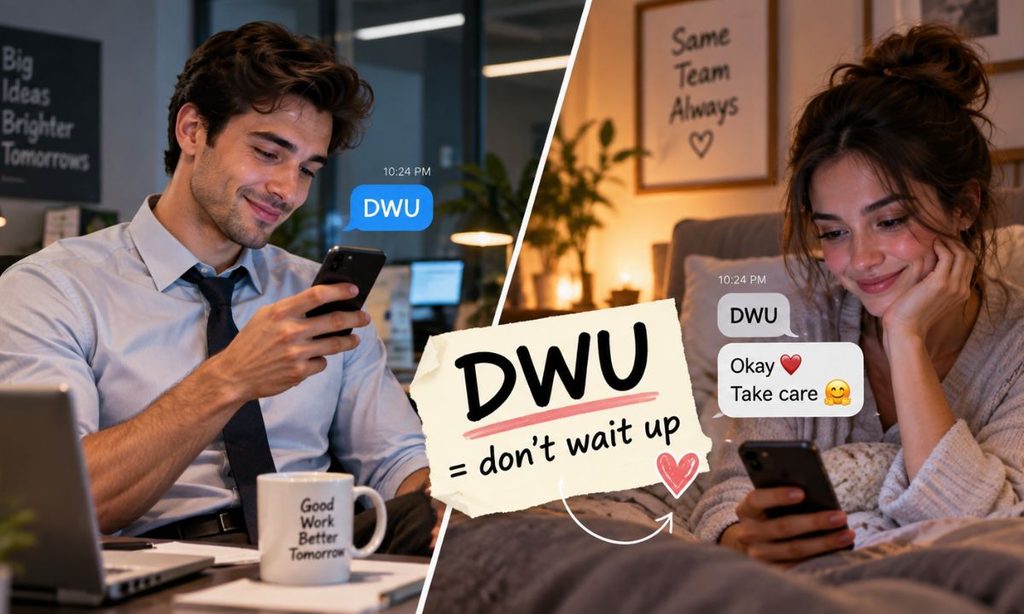
Some guides claim DWU carries a different meaning depending on whether a guy or a girl sends it, framing it as more casual coming from a guy and more emotionally loaded coming from a girl. That distinction isn’t linguistically supported. DWU means the same thing, “don’t wait up,” no matter who types it.
What actually changes the tone isn’t the sender’s gender, it’s the relationship and the situation. A DWU between roommates who barely know each other’s schedules reads very differently from a DWU between two people in an early, uncertain stage of dating, but that difference comes from context and history, not from who happens to be on the other end of the phone.
Origin And Evolution Of DWU
“Don’t wait up” existed in spoken English long before texting, typically said out loud as someone left the house for the night. As SMS and early instant messaging pushed people to compress common phrases into acronyms in the 2000s and 2010s, the spoken phrase got shortened the same way plenty of other everyday expressions did.
From there it carried over naturally into texting, group chats, and eventually social platforms, where it now shows up as a quick sign-off before someone goes quiet for a stretch of time.
Psychological And Emotional Meaning Of DWU
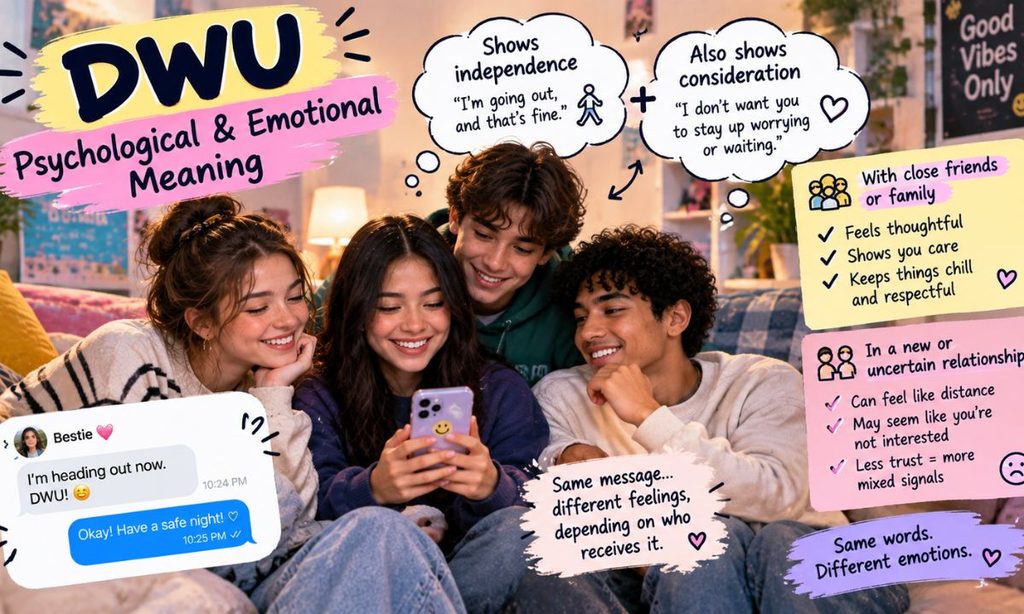
DWU does two things emotionally at once. It signals independence, “I’m going to be out and that’s fine,” while also showing a bit of consideration, since the sender is thinking about whether the other person might otherwise stay up worrying or waiting.
How it lands depends heavily on the relationship. Between close friends or family, it usually reads as thoughtful. In a newer or more uncertain relationship, the same message can feel like it’s creating distance, simply because there’s less established trust to fall back on.
Communication Function Of DWU
Functionally, DWU works like a small release valve. It tells the recipient that no immediate response or continued attention is needed, which lets both people relax instead of one side wondering if they should keep checking their phone.
That makes it especially useful in situations where a full explanation isn’t necessary, like a late work shift, a night out, or travel that runs long.
Also Read This:TW Meaning in Text: What Does TW Mean & How to Use It?
Cultural And Generational Context Of DWU
The phrase has roots in household habits, specifically the idea of family members literally waiting up for someone to get home safely. That norm predates texting by decades.
Younger texters have broadened the phrase well past that original household context. It now shows up between friends, situationships, coworkers, and gaming groups, not just people who live together or check in out of habit.
Why DWU Became Popular
Texting became the default way people manage plans and expectations, which created a need for a quick, low-effort sign-off phrase. As casual late nights, spontaneous plans, and long gaming or work sessions became more normal to text about in real time, a short way to say “don’t hold out for me” filled an obvious gap.
Semantic Core Meaning Of DWU
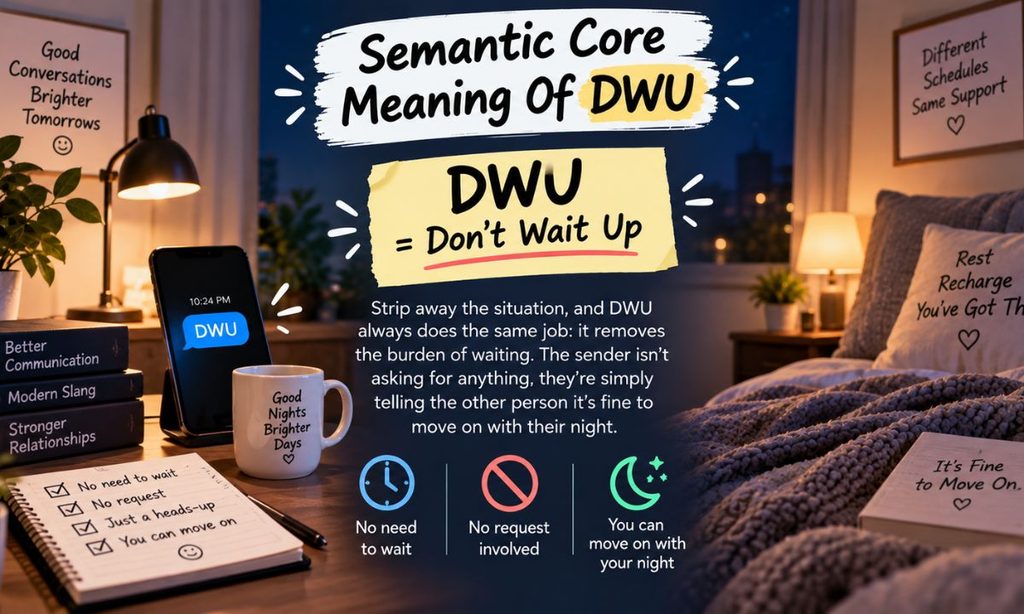
Strip away the situation, and DWU always does the same job: it removes the burden of waiting. The sender isn’t asking for anything, they’re simply telling the other person it’s fine to move on with their night.
Most Common DWU Meaning In Text (Deep Dive)
“Don’t Wait Up” is by far the dominant, most consistently documented meaning of DWU across texting and social platforms. It typically shows up in situations like:
- Staying out late with friends
- Working a late shift or unexpected overtime
- Traveling home later than planned
- A long gaming session that’s running past a normal bedtime
- Heading somewhere without a fixed return time
Nearly every well-documented source agrees on this meaning, which makes DWU one of the more consistently defined pieces of texting shorthand.
Meaning Based On Context
DWU almost always means “Don’t Wait Up,” but the emotional weight shifts with who’s sending it.
| Relationship | Likely Tone |
|---|---|
| Close friends | Casual, no deeper meaning |
| Family members | Considerate, practical |
| Established romantic partner | Warm, routine check-in |
| Early-stage dating or situationship | Can feel ambiguous or distancing without more context |
| Roommates | Purely logistical, about the apartment or shared space |
How DWU Is Used In Real Conversations
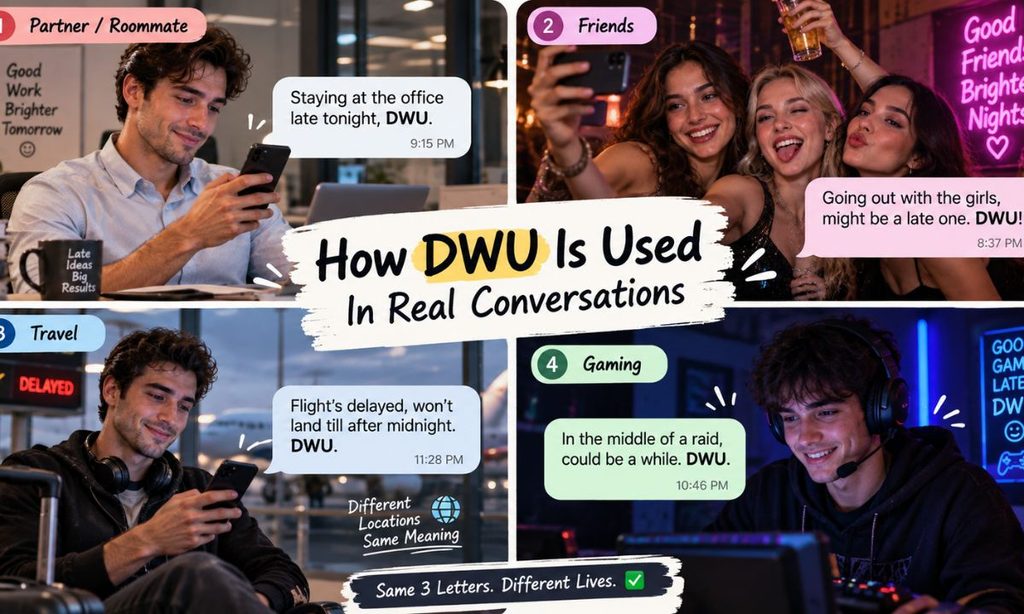
- “Staying at the office late tonight, DWU.” – a heads-up to a partner or roommate
- “Going out with the girls, might be a late one. DWU!” – a casual plan update between friends
- “Flight’s delayed, won’t land till after midnight. DWU.” – a practical travel update
- “In the middle of a raid, could be a while. DWU” – a gaming context update
DWU Meaning On Different Platforms
| Platform | Typical Usage |
|---|---|
| Texting/iMessage | Standard sign-off before going quiet for the night |
| Snapchat | Quick caption or chat message before heading out |
| Instagram DMs | Casual close to a conversation about plans |
| Twitter/X | Used loosely to share unavailability or late-night plans |
| Discord/gaming chats | Signals a long session or stepping away for a while |
| WhatsApp family groups | Practical heads-up about being home later than usual |
When To Use Vs When To Avoid DWU
- Use it with people who’d genuinely notice or worry about your availability, like close friends, family, or a partner
- Use it when you have a real reason for being unavailable, like work, travel, or plans running long
- Avoid it in professional messages, where it reads as confusing or overly casual
- Avoid sending it with zero context if the relationship is new, since it can come across as vague rather than considerate
Hidden Or Risky Meanings Of DWU
“Don’t Wait Up” is the meaning backed by the most consistent documentation, but a few other interpretations circulate in smaller pockets online:
- Do You Want – occasionally used to start a casual question, though far less common
- That’s What’s Up / Das Wassup – a niche, older expression of agreement seen in some slang dictionaries
A handful of sites also list backronyms like “Damn Girl, Yes” or “Don’t Worry, Understand.” These show up in user-submitted slang entries with little to no supporting usage elsewhere, so they’re worth treating as unverified rather than established meanings.
Variations And Forms Of DWU
DWU usually appears in lowercase in casual texts (“dwu”) and in all caps for a bit more emphasis (“DWU!”). Some people spell it out fully, “don’t wait up,” in messages meant to feel warmer or more sincere, while the abbreviated version tends to show up in faster, more casual exchanges.
DWU Vs Similar Slang
| Term | Meaning | Typical Use |
|---|---|---|
| DWU | Don’t Wait Up | Signals unavailability without needing a reply |
| OMW | On My Way | Signals imminent arrival, opposite direction of DWU |
| BRB | Be Right Back | Short, active break, not an overnight sign-off |
| GTG | Got To Go | Ends a conversation, doesn’t imply timing like DWU does |
How To Decode The Correct Meaning
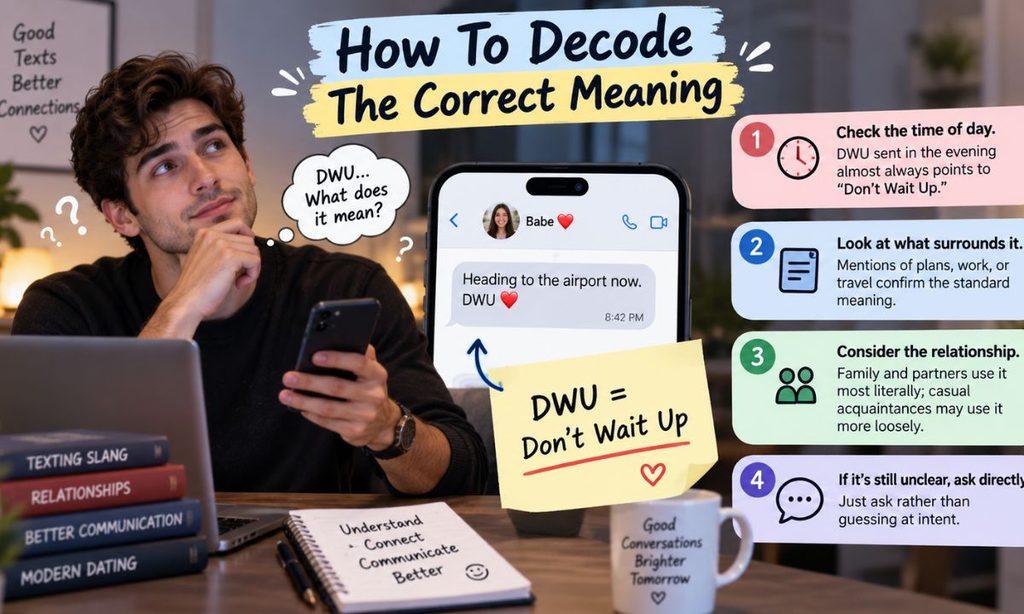
When DWU shows up and the meaning feels unclear, this quick process usually settles it:
- Check the time of day. DWU sent in the evening almost always points to “Don’t Wait Up.”
- Look at what surrounds it. Mentions of plans, work, or travel confirm the standard meaning.
- Consider the relationship. Family and partners use it most literally; casual acquaintances may use it more loosely.
- If it’s genuinely ambiguous, just ask directly rather than guessing at intent.
How To Respond To DWU
- Keep it short and low-pressure: “sounds good, have fun” or “okay, be safe”
- Avoid over-asking for details unless you’re genuinely concerned, since DWU is meant to end the back-and-forth, not start one
- If you are worried, it’s fine to say so directly rather than reading into the message itself
Dwu meaning in text urban dictionary
Urban Dictionary’s entries for DWU are thinner and less consistent than for more established slang terms. The majority of submissions point to “Don’t Wait Up,” which lines up with the wider documentation, but a few entries list joke definitions or one-off interpretations with no real evidence of common use elsewhere. Crowdsourced pages like this are useful for spotting what’s circulating, but they shouldn’t be treated as equally reliable as a term’s most consistently repeated meaning.
Common Misunderstandings About DWU
- Confusing it with “Don’t Wake Up,” which doesn’t make practical sense as a text, since a sleeping person wouldn’t be reading it anyway
- Assuming DWU always signals distance or disinterest, when in most cases it’s simply a practical update
- Thinking DWU is exclusive to romantic texting, when it’s just as common between friends, family, and roommates
- Believing the meaning changes based on the sender’s gender, which isn’t supported by how the term is actually used
Regional And Cultural Usage Of DWU
DWU is most recognized in English-speaking, casual texting cultures, particularly among younger users in Western countries. In regions where English isn’t the primary language, the phrase is understood mostly in tech-savvy or heavily online circles rather than being a universal piece of slang.
Frequently Asked Questions
Does DWU ever mean “Don’t Wake Up”?
No, that’s a common misreading. The correct and consistently used meaning is “Don’t Wait Up.”
Is DWU only used between romantic partners?
No, it’s just as common between friends, family members, and roommates letting each other know they’ll be out or unavailable late.
Does DWU mean something different depending on whether a guy or girl sends it?
No, the core meaning stays the same either way. What actually changes the tone is the relationship and situation, not the sender’s gender.
Is it rude to send DWU without explanation?
Not inherently, though pairing it with a quick reason, like “running late, DWU,” tends to read as more considerate than sending it alone.
What’s a good way to reply to DWU?
A short, low-pressure reply like “sounds good, be safe” works well, since DWU isn’t usually inviting a longer conversation back.
Conclusion
DWU is a small, practical piece of texting shorthand with one dominant, well-documented meaning: don’t stay up waiting for me. It shows up across friendships, families, and relationships alike, and its tone depends far more on the relationship behind it than on who happens to be sending it.
Once you know to read it as a considerate sign-off rather than a hidden signal, DWU stops being confusing and just becomes one more piece of everyday texting shorthand.


Pingback: IWK Meaning in Text: What Does IWK Mean & How to Use It?