
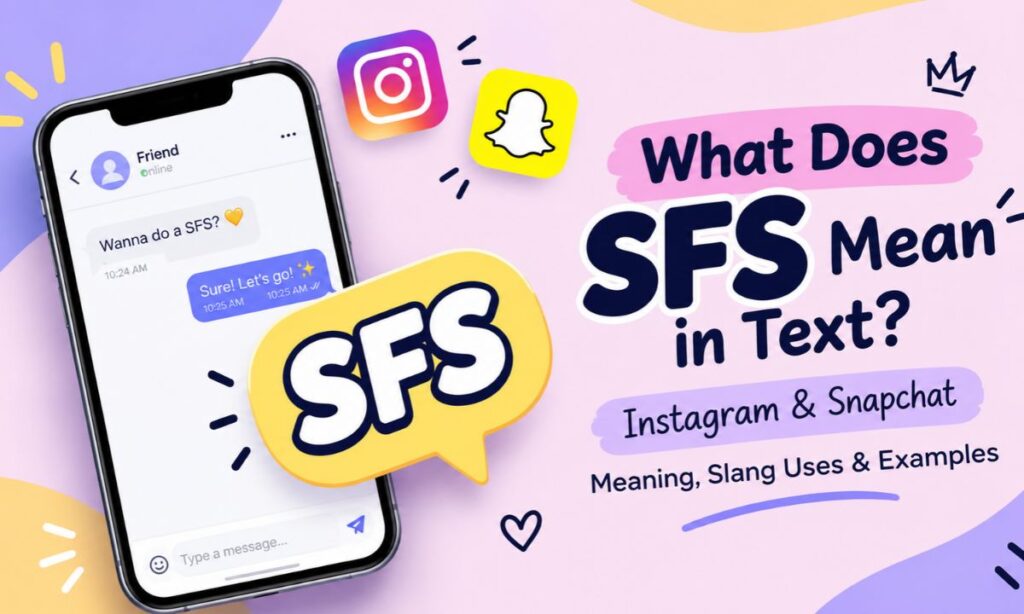

SFS is one of those short, unglamorous abbreviations that shows up constantly on Instagram and Snapchat and confuses almost everyone the first time they see it. It stands for “Shoutout for Shoutout” in most cases, though the exact meaning shifts depending on the platform and the conversation around it.
This guide covers what SFS means in text, how it works differently on Instagram versus Snapchat, why people use it, and how to handle a request if one lands in your DMs. By the end, you will be able to spot the meaning instantly instead of guessing.
What Does SFS Mean in Text?

SFS most commonly stands for “Shoutout for Shoutout.” It describes a mutual promotion arrangement where two users agree to feature or tag each other, usually to grow followers or boost engagement without paying for ads.
On Snapchat specifically, SFS often stands for “Snap for Snap” instead, referring to trading snaps back and forth rather than tagging someone publicly. Both versions share the same core idea: one person does something, and the other person does the same thing in return.
A Simple Example (Like You’re 5 Years Old)
Imagine two kids trading stickers. One kid gives a sticker, and the other kid gives one back. Nobody pays money, and both kids end up with something new.
SFS works the same way online. One person shares or tags the other person’s account, and the other person does it right back. Nobody pays for the exposure. Both accounts just end up in front of new people.
Where Do People Use SFS?
SFS shows up most on the platforms built around visual content and follower counts:
- Instagram, in captions, Stories, and comments
- Snapchat, in Stories and direct chats
- TikTok, mostly in comment sections, though it is less common there
- Group chats and DMs where creators coordinate a trade
Why Do People Use SFS?
People turn to SFS because it is a free, fast way to reach a new audience. Instead of spending money on ads, two accounts simply agree to promote each other.
It is especially common among smaller creators, influencers, and teens who want to grow a following. Pairing up with an account of similar size (or a slightly bigger one) puts a profile in front of people who might not have found it otherwise.
Does SFS Mean Something Different From a Girl or a Guy?
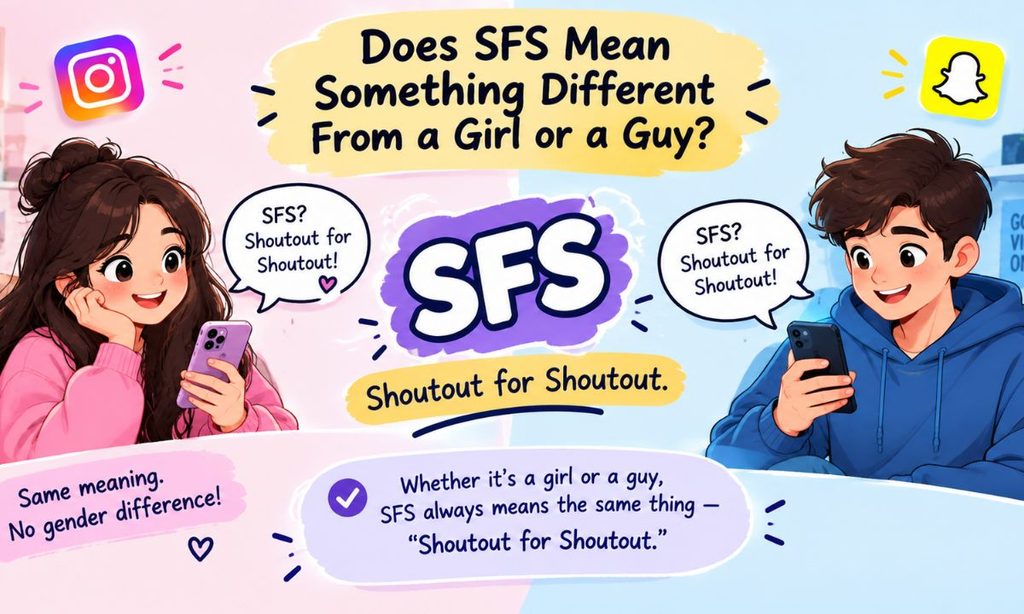
No. SFS does not change meaning based on who sends it. The definition depends entirely on the platform and the situation, such as whether it is used in a growth-focused Instagram caption or a casual Snapchat exchange, not on the gender of the person typing it. If you see claims that SFS means something different “from a girl” versus “from a guy,” that distinction is not accurate.
SFS Meaning on Instagram
On Instagram, SFS almost always means “Shoutout for Shoutout.” A user posts or tags another account in a Story or caption, and the other user returns the favor by doing the same thing. It is a simple, no-cost way for two accounts to cross over into each other’s audiences.
You will typically see it written as a hashtag, like #SFS, or as a direct request such as “SFS with me?” in a comment or DM.
Also Read This:What Does NTM Mean in Text? Viral Chat Slang Meaning & Examples (2026 Guide)
SFS Meaning on Snapchat
On Snapchat, SFS more often means “Snap for Snap,” though “Shoutout for Shoutout” is still used there too. In practice, someone sends a snap and expects one sent back, which can also help maintain a Snapstreak between two users.
It can also refer to a shoutout exchange on Snapchat Stories, similar to how it works on Instagram, just with a smaller, more private audience since Snapchat Stories are seen mainly by mutual friends.
Is SFS Only About Followers?
Not entirely, though follower growth is the most common reason it gets used. SFS can also be about keeping a Snapstreak alive, staying active in a friend group, or simply acknowledging another person’s content without any growth strategy behind it.
Among close friends, an SFS exchange is often just a casual way to support each other rather than a calculated move to gain followers.
Can SFS Have Other Meanings?
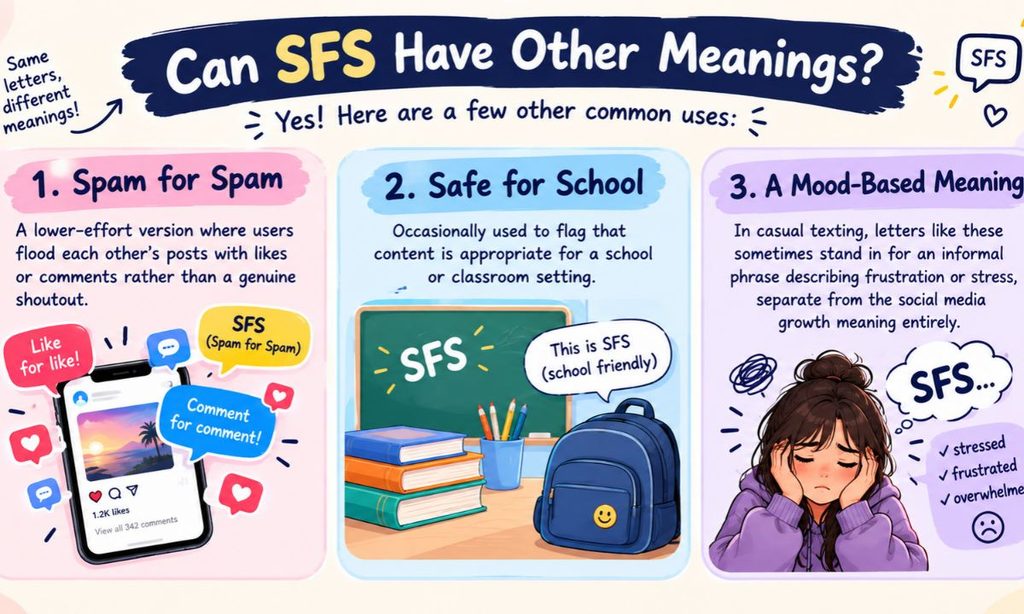
Yes, though these are far less common than the shoutout and snap trading meanings. Depending on where you encounter it, SFS can also refer to:
- Spam for Spam, a lower-effort version where users flood each other’s posts with likes or comments rather than a genuine shoutout
- Safe for School, occasionally used to flag that content is appropriate for a school or classroom setting
- A mood-based abbreviation in casual texting, where letters like these sometimes stand in for an informal phrase describing frustration or stress, separate from the social media growth meaning entirely
If SFS shows up outside a social media growth context, especially in a private text rather than a caption or Story, it is worth reading the surrounding message before assuming it means “shoutout.”
Problems People Face With SFS
SFS is not always a smooth exchange. Common issues include:
- One person following through and the other never posting their end
- Mismatched audience sizes, where a much bigger account gets little benefit from a much smaller one
- Low-quality followers who unfollow shortly after the trade
- Feeling pressured to say yes to someone you do not actually want to promote
Solutions to SFS Problems
Most of these problems have straightforward fixes:
- Agree on timing before either person posts, so both sides follow through around the same time
- Look for accounts with a similar following size and genuinely overlapping audience
- Screenshot or save the agreement if it is with someone you do not know well
- Treat it as optional. A polite decline is always fine if the trade does not feel worth it
How to Ask for SFS (Kind and Friendly Way)
Asking for an SFS works best when it is direct but low-pressure. A message like “Hey, love your content, would you be down for an SFS sometime this week?” gives the other person room to say yes or no without awkwardness. On Instagram or Snapchat, a quick “SFS?” in a comment or chat is also common shorthand once two accounts already have some familiarity with each other.
When Should You Say No to SFS?
It is worth declining when the request comes from an account that does not match your content, feels spammy, or seems focused purely on inflating numbers rather than genuine engagement. It is also fine to say no simply because you are not interested, even if the request is polite. A short “thanks, but I’ll pass” is a perfectly normal response.
Is SFS Allowed by Instagram or Snapchat?
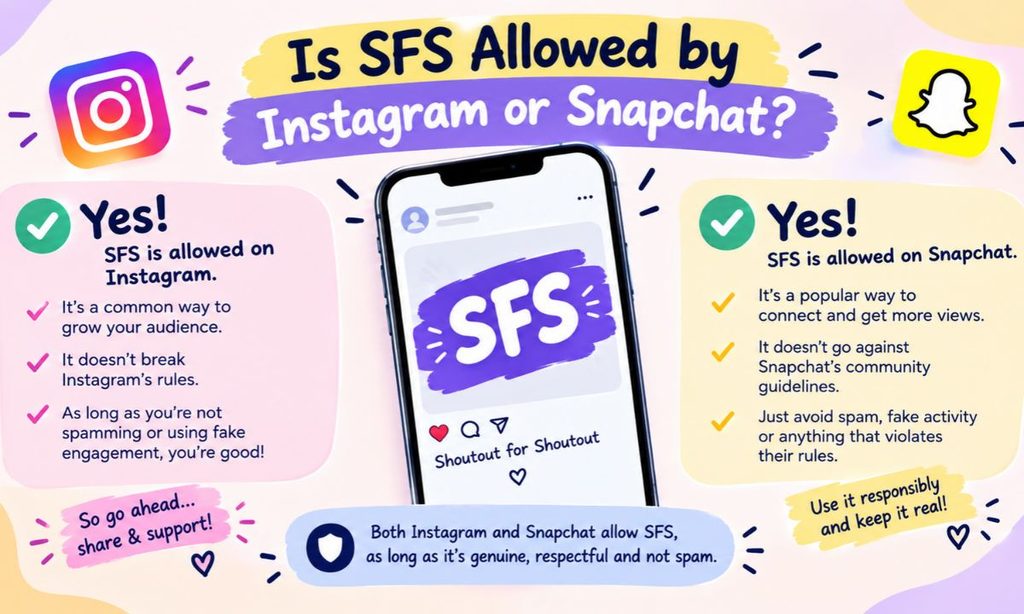
Yes, a genuine shoutout or snap exchange between real users does not break either platform’s rules. What can cause problems is using bots, fake engagement, or coordinated spam tactics to fake an SFS result, since both Instagram and Snapchat actively work to limit inauthentic engagement. A normal, one-to-one SFS between real accounts is simply a form of organic cross-promotion.
SFS vs Other Social Media Slang
| Term | Meaning | Most Common Platform |
|---|---|---|
| SFS | Shoutout for Shoutout, or Snap for Snap on Snapchat | Instagram, Snapchat |
| S4S | Shoutout for Shoutout (numeral version of SFS) | |
| F4F | Follow for Follow | Instagram, X/Twitter |
| L4L | Like for Like | Instagram, TikTok |
| Spam for Spam | Trading likes or comments in bulk rather than a shoutout |
FAQ
What does SFS mean on Snapchat?
On Snapchat, SFS usually means “Snap for Snap,” though it can also mean “Shoutout for Shoutout” depending on the conversation.
What does SFS stand for in general?
SFS most commonly stands for “Shoutout for Shoutout,” a mutual promotion trade between two social media accounts.
Is it rude to say no to an SFS request?
No. A polite decline is completely normal, and most creators understand that not every SFS request is a good fit.
Does SFS always relate to social media growth?
Mostly, yes, though it occasionally appears with unrelated meanings like “Safe for School” or as informal mood-based texting slang outside the growth context.
How is SFS different from F4F or L4L?
SFS is about trading shoutouts or snaps, while F4F and L4L specifically refer to trading follows or likes rather than a public tag or feature.
Conclusion
SFS almost always comes down to a simple trade: you promote me, I promote you. On Instagram that usually means Shoutout for Shoutout, and on Snapchat it often means Snap for Snap, though both platforms use the term loosely. Once you know the platform and the context, SFS stops being confusing and just reads as what it is: a quick, informal way for two accounts to help each other out.



Pingback: What Does TBT Mean in Slang? TBT Meaning on Social Media & Examples